
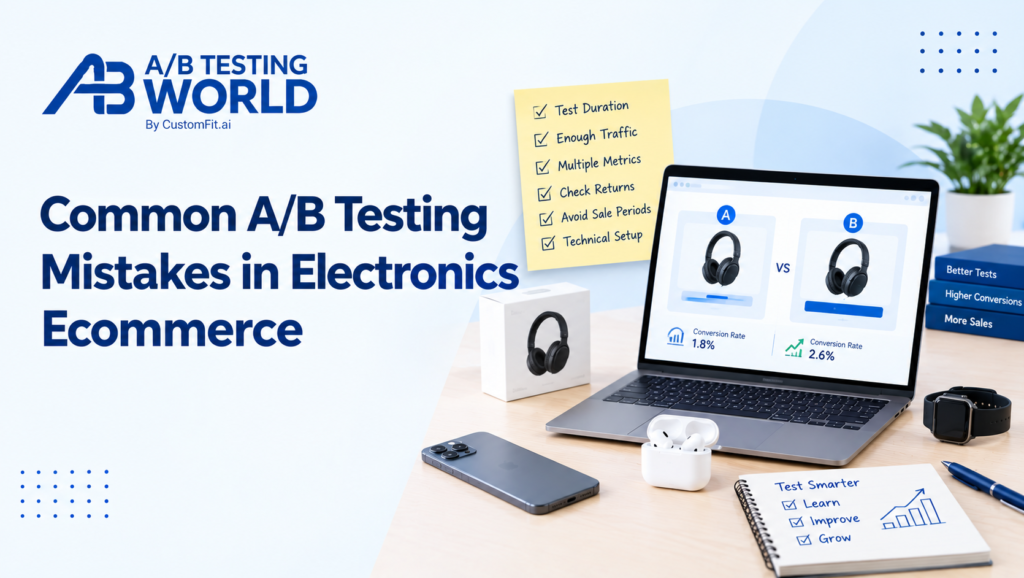
Most A/B tests don’t fail because the idea was bad. They fail because of how the test was set up, run or read. Electronics stores are especially exposed to this, because the products are expensive, the buying cycle is long and the pages are complicated.
Here are the mistakes that come up most, and what to do instead.
1. Stopping the test too early
This is the most common one. After three days one version is ahead, someone gets excited and the test is called.
The problem is that early results are noisy. A few big orders can swing everything, and weekdays behave differently from weekends. With electronics, it’s worse, because shoppers often take a week or more to decide. A test that ends in three days misses most of the people who will eventually buy.
Do this instead: Decide how long the test will run before you start. Two to three full weeks is a sensible minimum for most electronics stores.
2. Testing with too little traffic
If a product page gets a few hundred visitors a month, no test on it will give a clear answer. Many electronics stores have large catalogs, but traffic is spread across many products.
Do this instead: Test on category templates, or on your top few pages. Make bigger changes, since small ones are hard to detect. Run fewer tests at once.
3. Judging only by conversion rate
A variant can raise conversion and still hurt the business. A discount might boost sales but eat the margin. A pushy message might raise orders and raise returns.
Do this instead: Track a main metric, such as revenue per visitor, and guardrails like average order value, margin and return rate. Judge a test on all of them.
4. Ignoring returns
Returns are a big deal in electronics. If a change convinces more people to buy the wrong product, you’ll see more returns and unhappy customers a few weeks later.
Do this instead: Look at return rates for each variant after enough time has passed. Be cautious about wins that depend on hiding information shoppers need.
5. Overloading pages with specs
Many stores respond to hesitation by adding more information. More specs, more badges, more tabs. Beyond a point, more makes the page harder to use.
Do this instead: Test clarity. A plain-language summary and a few key specs near the top often beat a longer table. Try removing things as well as adding them.
Read Also: 25 Essential Tools for Marketers in 2025
6. Changing too many things at once
When you change the headline, the images, the button and the layout in one go, you won’t know which one made the difference.
Do this instead: Change one thing per test where you can. If you do a larger redesign, treat it as one test of the whole design, and don’t claim to know which part worked.
7. Running tests during sales and calling the result normal
Black Friday, launch days and big promotions bring in different kinds of shoppers. Bargain hunters behave very differently from your usual visitors.
Do this instead: Avoid ending tests during major promotions. If you must run through one, analyze that period separately.
Avoid These Mistakes With Cleaner Tests
Set up, run and read your A/B tests properly. Use every CustomFit.ai feature free for 14 days.
8. Not checking the technical setup
Tests can break quietly. A variant might load slowly, flash the original page, show differently on certain browsers or fail to record orders.
Do this instead: Before launch, check the variant on mobile and desktop, on different browsers and on a slow connection. Confirm that orders are tracked against the right variant. Check page speed, since electronics pages are heavy to begin with.
9. Ignoring mobile
Many electronics shoppers browse on phones, even if they buy on a laptop later. A variant that looks great on desktop can be awkward on mobile.
Do this instead: Check results by device. A test that wins on desktop and loses on mobile needs a different approach, not a blanket rollout.
10. Copying other stores’ winners
An idea that worked for a big retailer may not work for you. Their traffic, brand and customers are different.
Do this instead: Treat other stores’ tests as sources of ideas, not proof. Test them on your own visitors.
11. Not recording what you learned
Without a log, the same ideas get tested again and again, and the lessons are lost when someone leaves.
Do this instead: Keep a simple record for every test: hypothesis, change, dates, result and next step. Include the ones that lost.
12. Throwing away “flat” results
A test with no clear winner isn’t a waste. It tells you that the change doesn’t matter much, which saves you from investing in it further.
Do this instead: Note flat results, and move on to a test with more potential.
Run Your Next Test the Right Way
Use the checklist, then put it to work on your own store. Try CustomFit.ai free for 14 days, cancel anytime.
A short pre-launch checklist
- Is there a clear hypothesis?
- Do I know how long it will run?
- Is there enough traffic on this page?
- Have I picked a main metric and guardrails?
- Does it work on mobile and desktop?
- Is page speed acceptable?
- Is tracking confirmed?
- Is it free of major sale periods?
If you can answer yes to all eight, you’re in a better position than most.
Next step
If you’d like help setting up tests properly on your electronics store, you can book a demo call with us. We’ll look at your setup and traffic togethe
Read Also:
- What Is A/B Testing: How To Do It and Practical Examples
- Why A/B Testing Is the Cheapest Growth Lever Most Brands Ignore
FAQs
How long should an electronics A/B test run?
At least two to three full weeks. Electronics shoppers take longer to decide, so short tests miss many buyers.
What metrics should I track besides conversion rate?
Revenue per visitor, average order value, margin and return rate. A change that raises conversion but hurts these may not be a win.
Is it okay to run tests during Black Friday?
You can, but don’t treat the results as normal behavior. Sale shoppers behave differently, so analyze that period separately or avoid ending tests then.
What if my test shows no winner?
That’s still useful. It tells you the change doesn’t matter much, so you can spend your time on something with more potential.

