
Running one or two A/B tests is easy. Running a testing program that keeps improving your store for a year is harder, and the difference is usually a roadmap.
A roadmap is a plan for what you’ll test, in what order and what you hope to learn. For electronics brands it matters even more, because the products are expensive, the buying cycle is long and traffic is often thin on each product page. Random testing wastes both time and visitors.
Step 1: Decide what success means
Start with the numbers, before any ideas.
Pick one main metric for the roadmap. For most electronics stores, revenue per visitor works well, because it captures conversion and order value together.
Then choose two or three guardrail metrics that must not get worse:
- Return rate
- Average order value
- Margin, if you can measure it
- Page speed
A test that raises conversion but sends more products back isn’t a winner, and guardrails protect you from fooling yourself.
Step 2: Map the funnel and find the biggest leak
Look at where shoppers drop out.
- Landing page or category page to product page
- Product page to add to cart
- Add to cart to checkout
- Checkout to order
- Order to repeat purchase or accessory purchase
Split the numbers by device and by new vs. returning visitors. In electronics, the biggest drop is often between the product page and add to cart, because shoppers are still deciding, or at checkout, where shipping costs and payment worries show up.
Remember the buying cycle too. A visitor may look at your laptop on Monday and buy on Saturday. Look at conversions over a window that matches how long your customers take.
Step 3: Gather ideas from real evidence
Don’t plan from opinions alone. Look at:
- Customer support questions. What do people ask before buying?
- Reviews and returns. What do customers say about the product, and why do they send it back?
- Session recordings and heatmaps. Where do shoppers get stuck?
- Site search. What do they look for and not find?
- Past tests. What worked, and what can you build on?
Write each idea as a hypothesis: “If we add a plain-language summary above the specs, more shoppers will add to cart, because they’ll understand who the product is for.”
Step 4: Prioritize
You’ll have more ideas than you can test. Score each on:
- Impact: how much it could move your main metric
- Confidence: how strong your evidence is
- Effort: how hard it is to build
Give each a 1 to 5 score. Start with the ideas that are high on impact and confidence and low on effort. Keep the scoring quick. It’s a tool for deciding, not a project.
Typical early ideas for electronics stores:
- Plain-language summary and key specs near the top
- Warranty and returns messaging near the button
- Cleaner compare tool
- Monthly payment amounts near the price
- Delivery date and stock status
- Accessory and bundle presentation
Read Also: Landing Page A/B Testing: Key Elements to Experiment With
Step 5: Check your traffic
Electronics catalogs are often large, with traffic spread across many products.
- Test on category templates or groups of similar products
- Focus on the top pages by traffic
- Make bigger changes, since small ones are hard to detect
- Run one or two tests at a time
- Allow at least two to three full weeks per test
If traffic is very low, consider Bayesian methods, which can give a more usable read on small samples, or focus on higher-impact changes only.
Turn Your Roadmap Into Live Tests
Launch round one of your 90-day plan without writing code. Use every CustomFit.ai feature free for 14 days.
Step 6: Plan around the calendar
Electronics sales have strong peaks: Black Friday, festive seasons, back to school, new product launches. Put them on the roadmap first.
- Finish important tests before the peak starts, so winners are live when traffic arrives
- Don’t end a test in the middle of a promotion and treat it as normal
- Plan launch pages separately, since launch behavior is unusual
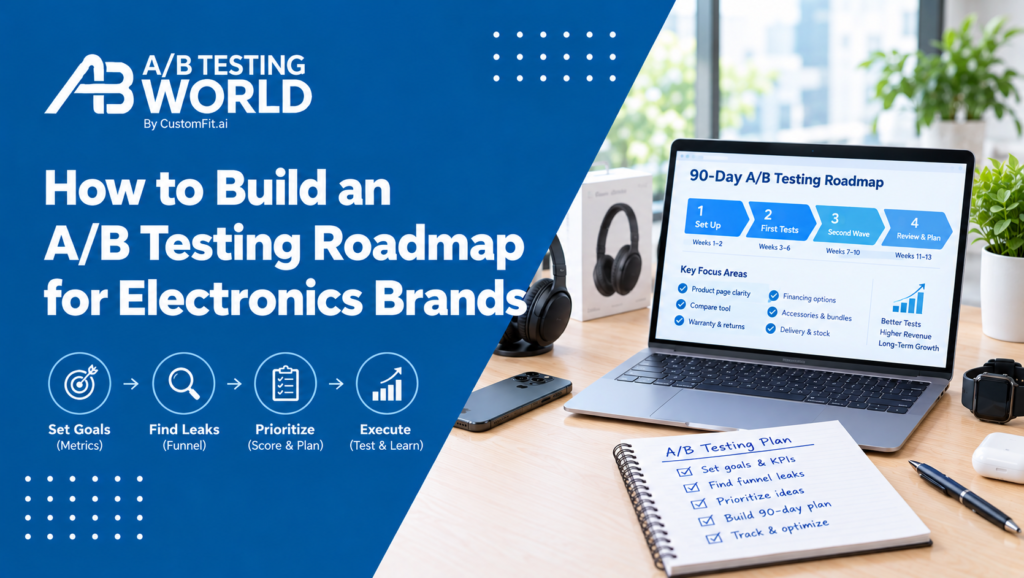
Step 7: Build a 90-day plan
Here’s a simple version you can adapt.
Weeks 1 to 2: Set up. Confirm tracking, choose your metrics, check page speed and finalize your top ideas.
Weeks 3 to 6: Round one. Run one or two tests on your biggest leak, such as product page clarity. Let each run for two to three weeks.
Weeks 7 to 10: Round two. Build on what you learned. Move to compare tools, financing display or accessories.
Weeks 11 to 13: Review. Gather results, roll out winners, record lessons and plan the next quarter.
Don’t plan too far past 90 days. What you learn will change your priorities.
Step 8: Keep a log
For each test, note the hypothesis, the change, the dates, the result and the next step. Include losers. Over time, this log becomes the most valuable asset in your program. It tells you what your customers respond to, and it stops you from repeating tests.
Step 9: Review every quarter
Every few months, step back and ask:
- Which tests moved the main metric?
- Which didn’t, and what did we learn?
- Has the funnel changed?
- Are there new questions to explore?
Update the roadmap, and drop ideas that no longer fit.
Start Round One This Week
Put your first test live on your own store. Try CustomFit.ai free for 14 days, cancel anytime.
Common mistakes
- Starting with ideas instead of metrics
- Skipping guardrails
- Testing too many things on too little traffic
- Ending tests too soon for a long buying cycle
- Not recording results
Next step
If you’d like help building a roadmap for your electronics store, you can book a demo call with us. We’ll look at your funnel and traffic and help you choose where to start
Read Also:
- Why A/B Testing Is the Cheapest Growth Lever Most Brands Ignore
- What Is A/B Testing: How To Do It and Practical Examples
FAQs
What is an A/B testing roadmap?
It’s a plan for which tests you’ll run, in what order and why. It keeps testing focused on your biggest opportunities and makes sure you learn from every result.
How long should an electronics roadmap cover?
A 90-day plan is a good starting point. What you learn in the first round will change what you test next, so avoid planning much further ahead.
What metrics should I use?
Choose one main metric, such as revenue per visitor, plus guardrails like return rate, average order value and page speed.
How do I prioritize test ideas?
Score each idea on impact, confidence and effort, then begin with ideas that score high on impact and confidence and low on effort.

