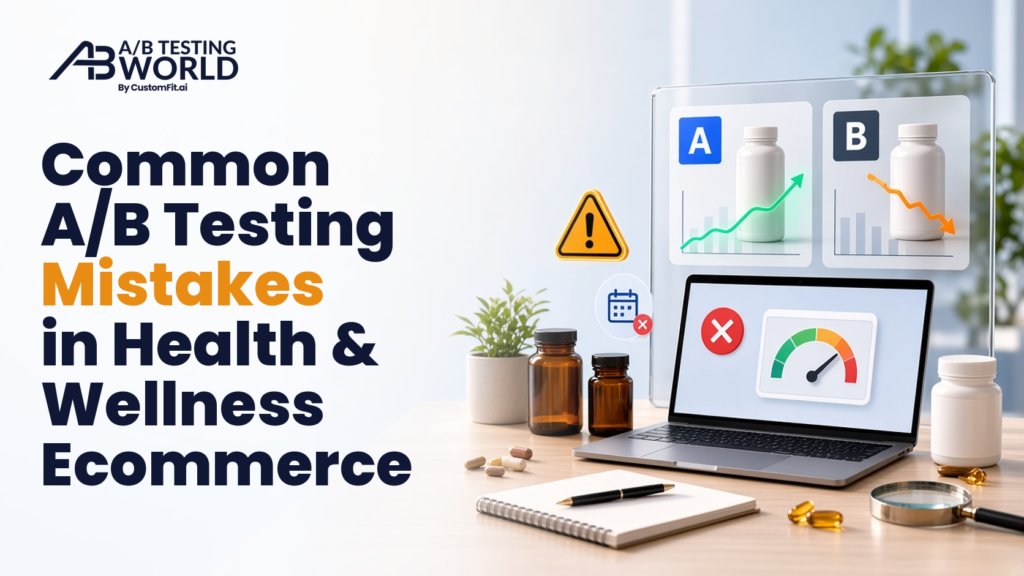
Most A/B testing mistakes in health and wellness ecommerce come from treating a supplement store like any other online shop. The product is bought on trust, it is often sold on subscription, and the real payoff shows up weeks after the first order. If you have already worked through our 10 A/B test ideas for health and supplement brands, this post covers the other half of the job: the errors that turn good ideas into misleading results.
Each mistake below explains what goes wrong, why it is common in this category and what to do instead. The list closes with a sample size table and a pre-launch checklist you can reuse.
Before you start: why A/B testing mistakes in health and wellness ecommerce happen
Three things set health and wellness ecommerce brands apart from fashion or electronics stores.
- Value arrives late: a protein powder or a magnesium supplement is judged on the second and third order, not the first.
- Trust carries the sale: shoppers want doses, sourcing, lab testing and a clear refund policy before they pay.
- Claims are regulated: in most markets you cannot say a product treats or cures anything, so copy tests have legal limits.
Keep these in mind. Almost every mistake on this list breaks one of them.
1. Judging subscription A/B tests on first-order conversion alone
A pre-selected subscribe-and-save option nearly always lifts subscription take-rate. That is the easy part. The harder question is whether those extra subscribers stay. A variant that pushes hesitant buyers into a plan they did not really want can raise sign-ups by 30% and then lose most of them before the third box.
What to do: treat subscription A/B testing as a two-stage read. Make conversion or subscription take-rate the primary metric for the decision, and record first-renewal rate and 90-day revenue per visitor as follow-up metrics. CustomFit.ai sets out a sensible order of tests in its subscription playbook. Whatever you pick, agree on the retention check before launch so nobody calls a winner after one week.
2. Counting active subscribers as new visitors
Logged-in subscribers visit the product page to change a flavor, skip a delivery or read the label again. They are not making a first purchase decision. If they land in your test, they water down the effect and can even reverse it, because a layout built to persuade newcomers may annoy someone who only wants the account menu.
What to do: exclude active subscribers from tests about first-purchase pages, or at least report them as a separate segment. A simple customer tag or cookie flag is usually enough.
3. Running tests shorter than a purchase cycle
Wellness shoppers compare. They read reviews, check ingredient lists on other tabs and come back days later. A test that runs from Monday to Friday sees the quick deciders and misses the careful ones, who are often the more valuable customers.
What to do: run every test for at least two full weeks, and longer if your analytics show a typical gap of seven days or more between first visit and purchase. Stop on a planned date or a planned sample size, never on a good-looking afternoon.
4. Testing health claims without a compliance check
It is tempting to test a bolder headline, such as “Fixes your sleep in 7 days” against “Supports restful sleep”. The bolder version may well win. It may also break advertising rules, invite complaints and get product listings removed. A test result does not make a claim legal.
What to do: have someone who knows the rules in your market approve every claim before it goes into a variant. Then test inside those limits. Specific, provable details usually beat vague promises anyway, for example the exact dose per serving, the name of the testing lab or the length of the money-back window.
5. Bundling every trust fix into one variant
Supplement product page work tends to produce a long list of fixes at once: certification badges near the title, a dose table, a results timeline, a stronger guarantee. Shipping all four in one variant is fine if you only want to know whether the new page beats the old one. It is a problem if you want to learn which change mattered, because you cannot pull the effects apart afterwards.
What to do: decide up front which question you are asking. For a full redesign, test the whole page and accept that you are measuring the package. For learning, test one change at a time, starting with the one your customer research flags most often.
Read more: How to Build an A/B Testing Roadmap for Wellness Brands
6. Starting without a sample size
Supplement ecommerce conversion rates are often in the 2% to 3% range on product pages, and many niche brands have modest traffic. That combination makes small effects very expensive to detect. Teams launch, watch the dashboard and stop when the numbers look exciting, which is how false winners get shipped.
What to do: calculate the required visitors per variant before you build the test. Our guide to the A/B test sample size formula walks through the math, and the table further down shows typical numbers for wellness stores. If the answer is more traffic than you will get in six to eight weeks, test a bigger change or move the test to a page with more visitors.
Test Supplement Page Ideas Without Code
Run trust, dosage and subscription tests on your product pages without developer time. Use every CustomFit.ai feature free for 14 days.
7. Ignoring mobile on supplement product pages
Most wellness traffic arrives on phones, often from social ads. Yet many tests are designed and reviewed on a laptop. A dose table that reads well on desktop can turn into a sideways-scrolling block on a small screen. A badge strip that fits one line on desktop may push the add-to-cart button below the fold on mobile.
What to do: review every variant on a real phone before launch and split the results by device. If the variant wins on desktop and loses on mobile, that is a finding to act on, not noise to average away.
8. Letting promotions and seasons decide the result
Health and wellness demand is seasonal. Immunity products rise in winter, weight management spikes in January and gifting bundles move in November and December. Sitewide sales change who visits and why. A test that overlaps a big promotion measures how deal hunters react, and that group may behave very differently from your usual buyers.
What to do: keep a calendar of planned sales and seasonal peaks, and avoid starting or ending a test across one. If a promotion cannot be avoided, make sure both arms see it equally and note it in the test log.
9. Skipping the sample ratio check
If you planned a 50/50 split and the final count is 52/48 on a large sample, something is broken. Common causes in this category include age-gate pop-ups, quiz redirects and subscription apps that reload the page, each of which can drop visitors from one arm. A result built on an uneven split cannot be trusted, whatever the p-value says.
What to do: run a chi-square check on visitor counts before you read any metric. Our explainer on sample ratio mismatch shows how to run it and how to trace the usual causes.
10. Reading quiz and bundle tests at the wrong level
Product finder quizzes and “build your stack” bundles are popular with wellness brands. They are also easy to misread. A quiz can raise click-through to product pages while lowering orders, because it sends people to products that do not fit. A bundle can raise average order value while cutting the number of buyers.
What to do: judge these tests on revenue per visitor and orders, with average order value and quiz completion as supporting metrics. Look at margin too. A three-product bundle with a 25% discount can grow revenue and shrink profit.
Sample size reality check for wellness stores
The table shows visitors needed per variant at 95% confidence and 80% power, with the time a store with 10,000 test visitors a week would need for a two-arm test.
| Baseline conversion rate | Relative lift to detect | Visitors per variant | Weeks at 10,000 visitors/week |
| 2% | 10% | 80,679 | 16.1 |
| 2% | 15% | 36,691 | 7.3 |
| 2% | 20% | 21,106 | 4.2 |
| 3% | 10% | 53,208 | 10.6 |
| 3% | 15% | 24,190 | 4.8 |
| 3% | 20% | 13,911 | 2.8 |
The pattern is clear. Small tweaks need traffic most wellness stores do not have, so early tests should target changes large enough to move conversion by 15% or more.
A pre-launch checklist
- One written hypothesis with a single primary metric and a planned stop date.
- Sample size calculated and checked against your real weekly traffic.
- Active subscribers excluded or tracked as their own segment.
- Every claim in the variant approved by whoever owns compliance.
- Variant checked on at least one iPhone and one Android device.
- No major sale or seasonal peak inside the test window.
- Retention and margin metrics agreed for subscription and bundle tests.
- Sample ratio check scheduled before anyone reads the results.
Pick One Mistake to Fix First
Begin with subscriber exclusion or a proper sample size and your next result will be one you can trust. Try CustomFit.ai free for 14 days, cancel anytime.
Where to start
If you only fix two things this month, fix the setup mistakes: exclude active subscribers and calculate sample size before launch. They cost nothing and protect every test that follows. Next, look at your trust elements, because that is where most supplement product page wins come from. The CRO guide for health and supplement brands has a useful priority table for that work, and the wider list of 15 common A/B testing mistakes covers the statistical errors that apply to every category.
Summary
Health and wellness ecommerce brands sell products whose value shows up over weeks, on pages where trust and regulation shape every word. The most costly testing mistakes ignore that: judging subscriptions on first orders, mixing subscribers with new buyers, cutting tests short, testing claims that are not allowed and reading bundles or quizzes on the wrong metric. Plan the sample size, protect the split, check mobile and agree on retention metrics up front, and your test results will hold up long after launch.
FAQs
What is the most common A/B testing mistake for supplement brands?
The most common mistake is judging a subscription test on first-order conversion alone. A variant can lift sign-ups and still lose money if those subscribers cancel early. Decide on conversion, then check first-renewal rate and 90-day revenue per visitor before rolling the change out to everyone.
How long should a health and wellness A/B test run?
Run it for at least two full weeks so you capture weekday and weekend behavior and slower, research-heavy buyers. Extend it if your typical time from first visit to purchase is longer than a week, and always stop on a planned date or sample size.
Should active subscribers be included in A/B tests?
Usually not for first-purchase pages. Active subscribers visit to manage orders, not to decide whether to buy, so they dilute the effect you want to measure. Exclude them with a customer tag, or report them as a separate segment if the change affects them too.
What is a good conversion rate for a supplement ecommerce store?
Many supplement product pages convert somewhere between 2% and 3%, though it varies widely with traffic source, price and brand awareness. Compare against your own baseline rather than an industry average, and use that baseline when you calculate the sample size for each test.
Can I A/B test health claims on my product pages?
You can test how you present approved claims, but a test does not make a claim legal. Have every claim reviewed for your market before it goes live. Specific, provable details such as dose per serving or third-party lab results are usually safer and often perform better.