A subscribe-and-save offer can raise expected lifetime value and still hurt the first order, or raise first-order conversion and raise churn two months later. That is why subscription ecommerce AB testing is a longer experiment than a button color test, and why churn has to be a guardrail, not a footnote.
This post covers subscribe and save ab test ideas (the default state, discount depth and the frequency picker), plus how to run a subscription default test and a subscription discount test without declaring victory on week one. It is written for stores that already sell a refillable or repeatable product, and it treats subscription ecommerce conversion as a pair of numbers: the first order and the orders that follow.
customfit.ai already ranks with A/B testing subscription plans. This article does not try to replace that guide. It stays on the test designs and on the guardrails that a plan-level article can leave implicit.
Subscription Ecommerce AB Testing: The Tests That Matter
Start with the default, then the discount, then the frequency. Changing all three at once will tell you that “the new subscription module” did something, and not much else.
A subscription default test. Variant A shows one-time purchase as the default, with subscribe-and-save as a choice. Variant B shows subscribe-and-save as the default, often with a smaller price, and one-time as the choice. This is usually the highest-impact test on a product page, and also the one most likely to annoy people who did not mean to subscribe. Measure first-order conversion and the share of orders that are subscriptions, then watch cancellation and skip rates for a full cycle.
A subscription discount test. Keep the default the same and change only the incentive: 5% versus 10%, or 10% versus a free-shipping subscription, or a first-order discount versus a standing discount. A deeper cut will often raise attach and can also train people to cancel and reorder when the discount period ends.
A frequency picker test. Offer 30 days versus 30 and 60, or hide the picker behind the subscribe option versus showing it up front. The wrong default frequency creates early skips and cancellations that look like “subscription does not work” when the real issue is a 30-day default on a 50-day product.
A short first-order picture, to show why one number is not enough: 20,000 visitors see a one-time default and 20,000 see a subscribe default. The one-time default produces 800 orders (4.00%), of which 160 are subscriptions (20% of orders). The subscribe default produces 760 orders (3.80%), of which 380 are subscriptions (50% of orders). First-order conversion is down. Attach is up, and the number of new subscribers is up (380 versus 160). Whether you ship depends on the pre-registered rule and on the first-renewal review, not on a single close rate. If 60-day cancels in the variant are also much higher, the extra subscribers may not be worth it.
Other useful variants, once the three above are in motion:
- A subscribe offer on the product page versus only in the cart or after purchase.
- A post-purchase convert-to-subscribe offer on the thank-you page, for first-time one-time buyers.
- Prepaid or multi-month plans versus a standard renewing plan, if operations can support them.
- A reminder email before renewal versus no reminder, with skip and cancel as metrics.
- Copy that states the skip-or-cancel policy in the offer versus a shorter price-only line.
For pet food and other refill categories, some of these ideas already appear in our A/B test ideas for pet brands. The measurement rules below still apply.
What to Measure, and How Long to Wait
Subscription ecommerce conversion is not only the first-order close rate. A default that slightly lowers first-order conversion and doubles 90-day retained subscribers can be a win. A default that raises first-order conversion and doubles 60-day cancels is not.
Use a primary metric that matches the decision, and write a delayed guardrail into the plan:
- First-order conversion or first-order revenue per visitor, so you can see whether the page still sells.
- Subscription attach rate (subscription orders divided by orders, or new subscribers divided by visitors).
- Cancel, skip and failed-payment rates at the first renewal, and, if you can wait, at the second.
- Revenue over a fixed window (60 or 90 days) per assigned visitor, which is the closest simple stand-in for early lifetime value.
- Margin, if the discount is standing rather than first-order only.
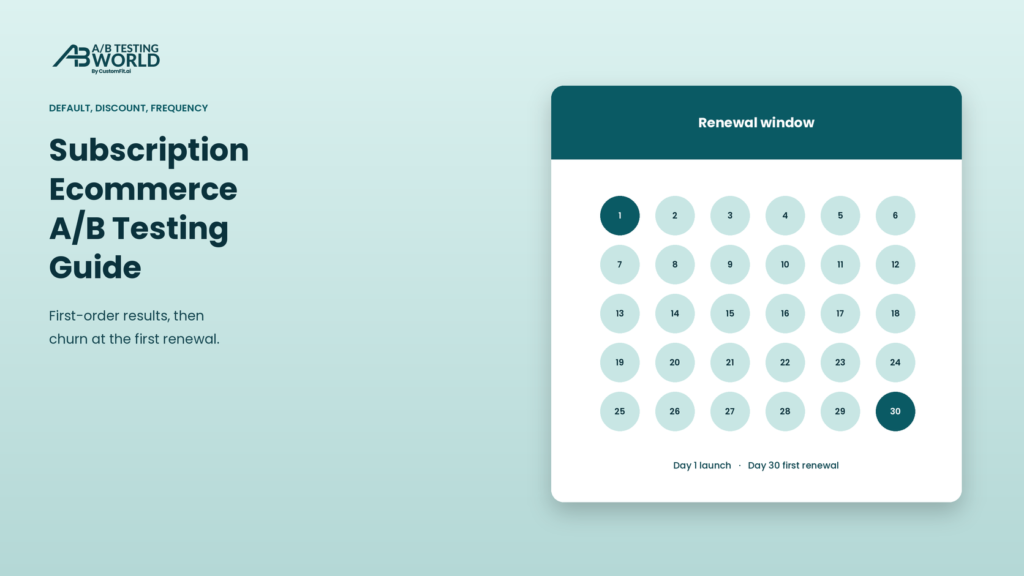
The renewal guardrail is why this work is slow. If the first renewal for a 30-day plan lands on day 30, a 14-day test cannot see churn. You can ship a page-level default on first-order evidence only if the plan says so, and only if you have a date to review cancels. Otherwise you are guessing. How long to run an A/B test still applies; for subscriptions the clock just includes the first renewal.
Assignment must be sticky across visits. A shopper who sees a subscribe default on Monday and a one-time default on Thursday is not in a test, they are in a mess. If they log in, hold the same variant on every device you can.
For the first-order metric, use the right metrics for A/B testing as the planning base, then add the delayed subscription numbers on top. Do not promote attach rate to the only primary metric if first-order conversion is falling sharply.
Read more: A/B Test Hypothesis Template: Write One You Can Test
Test the Default, Then the Discount
Run the subscribe-and-save experiment on your store, with first-order revenue and a planned renewal review. Try CustomFit.ai free for 14 days.
A Design That Holds Up in Review
Write the offer in one sentence: who is defaulted into what, at what discount, and how they get out. If the sentence is long, the UI is probably unclear.
Do not hide the fact that the item will renew. A pre-ticked subscribe option with the word “save” in a small font is a trust problem, and a lift in attach will not make it a good test. The variant should make the cadence and the cancel path obvious.
If the first result is a small drop in first-order conversion and a large rise in attach, do not average those into a single “good” or “bad.” Report both, wait for the renewal window if that was the plan, and then decide. A messy early ship is hard to undo once people are billed.
Operations has a veto. If fulfillment cannot pack a 60-day box, or if failed payments are not retried well, the test will measure operations, not the offer. Fix that first.
Kohavi, Tang and Xu, in Trustworthy Online Controlled Experiments, treat long-term effects as part of the decision, not as a later research project. A subscribe and save ab test is a direct application of that advice: the first-order lift is incomplete until the first renewal has been seen, or until the plan explains why it is safe to ship without it.
If the interval on first-order revenue crosses zero and attach is up, you have a trade-off, not a finished result. Park a deeper discount until you understand the current offer. An inconclusive first-order test is not a reason to “just raise the percent.” It is a reason to wait, or to simplify the UI.
A subscription discount test that only looks at attach will almost always prefer the deeper cut. Add margin and cancel rate, or you will buy subscribers you cannot keep.
Do not start with a prepaid annual plan if the current one-month offer is still unclear. The annual plan adds refunds, cash-flow and a long wait for a read, on top of the default-and-discount questions you have not answered. Get the default and the standing percent right first, then test a longer commitment.
Copy is part of the test, but it is not a substitute for the default. “Skip or cancel any time” next to the price can reduce accidental subscribers, and it should be in both arms if it is already a policy, or in one arm if you are testing whether saying it changes attach and later churn.
Test the Default, Then the Discount
Launch a subscribe-and-save default or discount test on your store, and review it again at the first renewal. Try CustomFit.ai free for 14 days, no credit card required.
A practical review date helps more than a vague “we will watch churn.” If the plan is a 30-day cadence, put a 45-day or 60-day read on the calendar when you launch, and name the owner who will pull cancel and skip rates. If nobody owns that date, the guardrail will not happen, and the default will stay in place by inertia, which is the most common way a week-two ship becomes a quiet long-term problem for the program.
Keep the written plan next to the renewal report, so the later read uses the same rule you launched with.
Summary
Subscription ecommerce ab testing is a sequence: a subscription default test, then a subscription discount test, then a frequency picker, with subscription ecommerce conversion read as first-order performance plus attach, and with cancel or skip rates as a delayed guardrail. A subscribe and save ab test that ships on week-two conversion alone can hide a churn problem at the first renewal. Keep assignment sticky, make the renew-and-cancel path obvious, and do not change the default, the discount and the cadence in one variant. For the wider planning view, use the customfit.ai subscription-plans guide and come back here for the experiment design.
FAQs
What should I test first in subscription ecommerce A/B testing?
Test the default state of the offer on a high-traffic product page: one-time as the default versus subscribe-and-save as the default, with the other option still visible. Then test discount depth, then the frequency picker. Changing all three at once will not tell you what to keep.
How do I run a subscribe and save A/B test without hurting trust?
Make the renewal, the price and the skip-or-cancel path obvious. Do not hide a pre-ticked subscription behind the word “save.” Measure first-order conversion as well as attach, and review cancels at the first renewal.
What is a subscription default test?
It is a test of which option is pre-selected, usually one-time purchase versus subscribe-and-save, with the same products and a planned discount. It often moves attach more than a copy test does, and it is also the variant most likely to create accidental subscriptions if the UI is unclear.
How should I judge subscription ecommerce conversion?
Look at first-order conversion or first-order revenue per visitor, and at the share of orders that are subscriptions. Then look at cancel, skip and failed-payment rates at the first renewal. A single close-rate win is not enough.
How long should a subscription discount test run?
Long enough to reach the planned first-order sample, and then until the first renewal for the churn guardrail, unless the pre-registered rule says you may ship on first-order evidence and review cancels on a set date. A 14-day window cannot see a 30-day renewal.
Can I convert one-time buyers after purchase instead of defaulting them on the product page?
Yes, and that is often a safer first test if you are worried about accidental subscriptions. Offer subscribe-and-save on the thank-you page or in a follow-up email, and compare incremental subscribers and later churn against a no-offer control.