A winning test tells you that a change beat its control for a few weeks. It does not tell you what a year of shipped winners, or a personalization program, did to the business. That is the job of a holdout group AB test: a slice of traffic that is kept off some or all of the new experiences so you can measure incrementality.
customfit.ai already covers holdout groups in experimentation. This article takes a narrower cut for incrementality testing ecommerce teams actually run: how a holdout group vs control group differs, what a universal holdout group is for, how to size and time the hold, and the pitfalls that make a holdout look more precise than it is.
Holdout Group vs Control Group
A control group is temporary. It is the “no change” side of one experiment, and it goes away when the test ends and the winner is shipped.
A holdout group is longer-lived. People in it continue to see a baseline experience (the old homepage, no personalization, or no new winners from a given date) while everyone else receives the program. Holdout testing is a comparison of a stream of changes against a frozen, or slowly changing, baseline.
You can have both at once. A new checkout test still needs its own control. The holdout sits above that, and answers a different question: after six or twelve months of shipped work, are we actually ahead of the experience we had at the start?
A universal holdout group is the version of this idea that is held out from a whole class of treatments, such as all merchandising tests, or all on-site personalization, rather than from a single campaign. It is “universal” inside a defined program, not a group that never sees any change on the website.
What a Holdout Group AB Test Can Measure
The two most useful jobs in incrementality testing ecommerce are:
- The combined lift of a year of winners. Individual tests can be significant, and the stack can still disappoint if winners fade, interact, or were over-counted. A holdout that never received those shipped changes is the cleanest way to see the net effect. Novelty and fade are part of that story; see novelty effect in A/B testing.
- The incrementality of personalization or targeting. A model that “works” in an offline score can still fail to beat a simple default. Keep a holdout on the default experience and read revenue per visitor, not only a model-quality chart.
A holdout is a poor tool for deciding a single button test. That is what a normal control is for. If you only run a few tests a year, a 10% holdout is usually a waste of traffic. Spend the sample on the tests themselves.
Sizing, Duration and Assignment
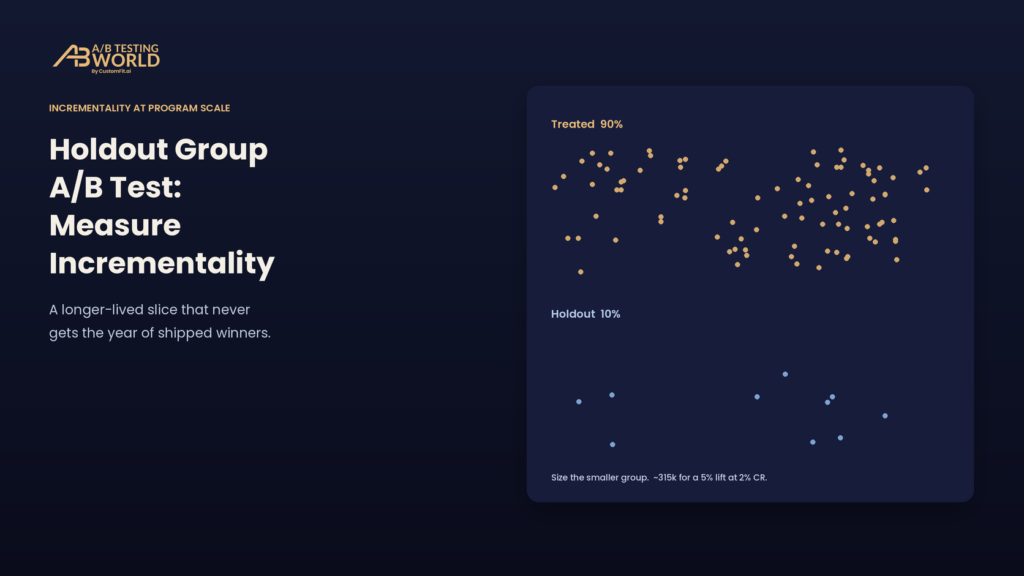
Power is dominated by the smaller group, which is the holdout. A two-proportion plan at 80% power and a 5% two-sided level, with a 2.00% baseline conversion rate, needs about 315,000 visitors per group to detect a 5% relative lift, and about 867,000 to detect a 3% relative lift.
That has a blunt implication. If you hold out 10% of a store that does 3 million assigned visits in a year, the holdout is about 300,000 visits. You are close to the sample for a 5% combined lift, and well short of the sample for a 3% lift. A 5% holdout on the same store is 150,000, which is not enough for a small annual effect. If the combined lift you care about is modest, you need a larger holdout, a longer window, or a noisier wait.
Revenue per visitor is usually the better primary metric for a program-level holdout, and it is noisier than conversion, so the sample grows again. Plan the metric and the duration together. Our A/B test sample size formula is the proportion version of this math; for revenue, use visitor-level spend and a mean-based calculation.
A simple planning view, still on a 2.00% baseline and a 5% relative lift at 80% power (about 315,000 in the holdout):
- 1 million assigned visits a year: a 10% holdout is 100,000, which is well short. A 30% holdout would get you close, and would also starve the test program. This store should probably not run a sitewide annual holdout until traffic grows, or it should hold out from one small program only.
- 3 million visits a year: a 10% holdout is about 300,000, close to the 5% lift figure and short of a 3% lift (about 867,000).
- 6 million visits a year: a 5% holdout is 300,000, and a 10% holdout is 600,000, which starts to make a smaller combined lift readable.
Those are conversion-rate sizes. If the primary metric is revenue per visitor, treat them as a lower bound and plan more traffic, or a longer window.
A personalization holdout and a “year of winners” holdout are not interchangeable. In the first, the treated group gets a model or a set of rules, and the holdout gets a simple default, such as the same homepage for everyone. In the second, the treated group accumulates shipped A/B winners, and the holdout stays on the site as it was on the start date, plus any change you must ship for legal or operational reasons. Do not mix the two in one group and then claim a single incrementality number.
Assignment must be sticky. If a person in the holdout can log in on a second device and fall into the treated group, the contrast shrinks and you will understate the program. Hold the assignment key (usually a visitor ID or a logged-in account) stable for the whole duration. A holdout that reshuffles every session is not a holdout.
Duration should cover the cycle you care about: at least one full season if you are measuring a year of winners, and long enough for repeat purchase if retention is part of the claim. Ending a twelve-month holdout in week six because the line looks good is peeking. The same discipline is in how long to run an A/B test.
Pitfalls
- A holdout that is too small. You will get a wide interval and a meeting that treats a noisy 2% as a precise 2%.
- A holdout that is too large. You starve the tests you still need to run. Most mid-size stores should start near 5% to 10%, then check the power math.
- Contamination. Shared devices, shared accounts, and merchandising that leaks into the holdout (a sitewide sale, a global banner) all dilute the contrast.
- Changing the baseline. If you quietly ship major changes into the holdout “because legal required it,” write that down. The group is no longer a frozen baseline.
- Double counting. Do not add every individual test lift to the holdout lift and call the sum your year. The holdout already is the combined number.
- Using the holdout as a spare control. If you exclude holdout traffic from a new test, say so in the test plan, and do not then treat the holdout as a third variant in that test.
Win rate at the test level can look healthy while the holdout is flat, which is a reason to measure both. See A/B test win rate.
Read more: Can You Run Multiple A/B Tests at the Same Time?
Measure the Program, Not Only the Test
Run clean on-site experiments first, then use a holdout when you need the combined effect of a year of work. Try CustomFit.ai free for 14 days.
If you are not ready for a universal holdout group, a lighter start is a holdout on one program only, such as personalization or promo popups, for one quarter, with revenue per visitor as the primary metric and a pre-registered sample. Learn the assignment and contamination issues there, then decide whether a sitewide hold is worth the traffic.
Holdout testing is a complement to, not a substitute for, ordinary A/B tests. You still need a hypothesis, a primary metric and a stable split on each change you ship. The holdout is there so a pile of local wins cannot hide a flat business.
Measure the Program, Not Only the Test
Start with disciplined on-site tests, then add a holdout when you need incrementality at program scale. Try CustomFit.ai free for 14 days, no credit card required.
People in the holdout should still get a fair store: working checkout, current prices you have to honor, and any security or legal change. A holdout is not a punishment group, and it is not a place to freeze broken experiences for a year. If the baseline itself is unacceptable, fix that first, then start the clock on incrementality.
Summary
A holdout group ab test keeps a slice of traffic off a program of changes so you can measure incrementality, not only the result of the last test. A holdout group vs control group is a duration and scope difference: the control ends with the test, the holdout lasts for the program. A universal holdout group is held out from a defined class of treatments, such as personalization or a year of shipped winners. Incrementality testing ecommerce teams should size the holdout from the smaller group: about 315,000 visitors per arm to detect a 5% relative lift on a 2% conversion rate at 80% power. If the holdout is smaller than that, the interval will be wide. Keep assignment sticky, watch contamination, and do not add individual test lifts on top of the holdout result.
FAQs
What is a holdout group in an A/B test program?
It is a longer-lived group that does not receive some or all of the new experiences you are shipping, so you can measure the combined effect against a baseline. It is not a replacement for the control group inside a single test.
How is a holdout group vs a control group different?
A control group is the “no change” side of one experiment and ends when that test ends. A holdout continues for months, or for a defined program, and answers whether the stream of shipped work (or a personalization system) was incremental.
What is a universal holdout group?
It is a holdout that is excluded from a whole class of treatments, such as all merchandising tests or all on-site personalization, rather than from one campaign. “Universal” means universal inside that program, not a group that never sees any site change at all.
How long should holdout testing last?
Long enough to cover the cycle you care about, often a quarter or a year for a program of winners, and long enough to include repeat purchase if retention is part of the claim. Do not end it early because the chart looks good in week six.
How do I size a holdout for incrementality testing in ecommerce?
Power comes from the smaller group. For a 2% baseline and a 5% relative lift, plan about 315,000 visitors in the holdout (and at least that many in the treated group) at 80% power. A 10% holdout on 3 million annual visits is about 300,000, which is close to that figure and short of a 3% lift.
What is the biggest pitfall in a holdout group A/B test?
Contamination and an underpowered holdout. If people can leave the holdout on a second device, or if the holdout is too small for the lift you care about, you will get a confident-looking number that does not mean much.