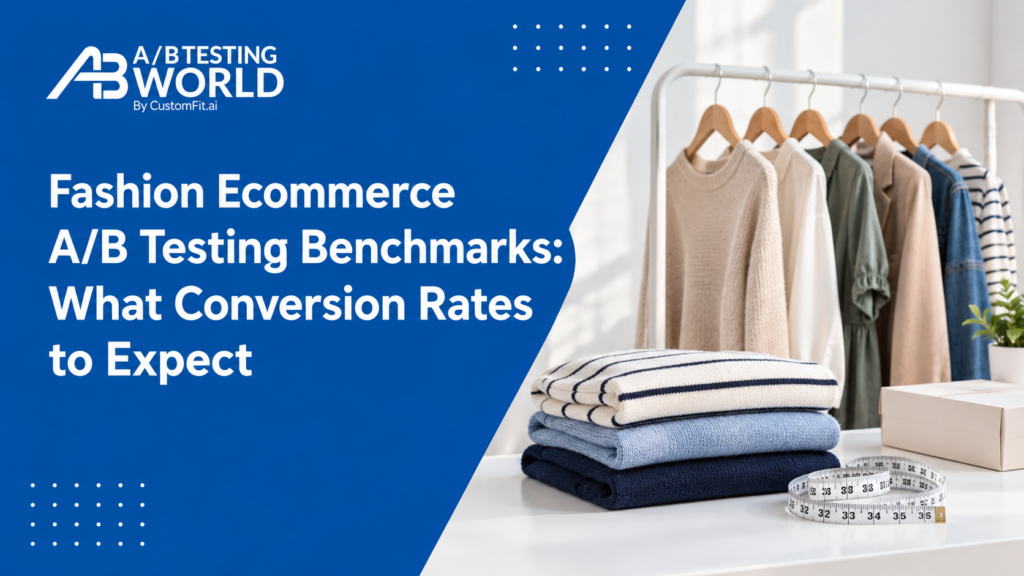
Fashion brands asking “what conversion rate should we expect” are usually looking for a single reassuring number. The more useful answer is that fashion ecommerce conversion rate benchmarks are shaped heavily by a factor most other categories don’t deal with at the same scale: sizing uncertainty. A shopper buying a book knows exactly what they’ll get. A shopper buying a dress in an unfamiliar brand’s sizing is making a genuine bet, and that uncertainty — more than design quality or traffic source alone — explains a lot of the variation you’ll see across different apparel brands’ numbers.
Why fashion benchmarks vary so widely
Apparel conversion rates are pulled in different directions by a few category-specific factors that don’t apply equally everywhere else:
Sizing confidence. A brand with a well-regarded, interactive size guide and strong fit feedback from customers will generally convert better than one with a static, unhelpful size chart, independent of almost any other site quality factor.
Return rate expectations baked into shopper behavior. Fashion carries structurally higher return rates than most categories, and shoppers increasingly factor this into their purchase decision upfront — a visible, generous return policy can measurably affect whether they complete checkout at all, not just what happens afterward.
Price point and consideration level. Fast-fashion, lower-commitment purchases convert differently than premium or considered apparel purchases, where a shopper is more likely to research, compare, and take multiple sessions to decide.
Apparel store conversion rate: what actually drives the range
Beyond sizing, a few other factors meaningfully shift the numbers:
Traffic source composition. Fashion brands driving heavy visual-platform traffic (Instagram, TikTok, Pinterest) often see different conversion patterns than those relying more on search or email, since visually-driven discovery traffic frequently arrives earlier in the consideration process.
Seasonality and trend cycles. Fashion conversion rates can swing meaningfully around seasonal launches, sales events, and trend cycles in ways that make any single benchmark number a poor fit for a brand measured outside that specific window.
Mobile traffic share. Fashion skews heavily mobile, particularly for younger-skewing brands, and mobile conversion rates in apparel specifically are sensitive to variant selector design and image loading speed in ways that can meaningfully pull an aggregate number down if not optimized well.
Test Your Size Guide and Return Policy
Measure real lift on your own store, not generic benchmarks. Run no-code A/B tests with CustomFit.ai, free for 14 days.
Fashion brand A/B test benchmarks: using them correctly
1. Compare your own segmented performance over time rather than an external blended figure. Your conversion rate this season against last season, holding traffic mix roughly constant, is a far more meaningful comparison than measuring against a generic “fashion ecommerce average” that blends fast fashion and premium apparel together.
2. Separate benchmark expectations by category within your own catalog. A well-understood, frequently-repurchased item (a basic t-shirt in a size you’ve bought before) converts differently than a first-time purchase of a more complex, fit-sensitive garment — blending these into one site-wide number obscures real differences worth tracking separately.
3. Treat controlled A/B test lift as more reliable than any benchmark comparison. A measured improvement from testing your size guide or return policy visibility against your own prior version tells you something concrete and actionable. A generic benchmark gap could be explained by dozens of unrelated factors.
Read Also: What Makes a Good A/B Test? Avoiding Common Mistakes
Clothing ecommerce KPI: metrics worth tracking alongside conversion rate
Conversion rate alone tells an incomplete story in fashion specifically, given how central sizing and returns are to the category’s real economics:
- Return rate, segmented by product and whether sizing tools were used, which can reveal whether your size guide is actually working or just present
- Exchange versus refund rate, since a high exchange rate (rather than refund) often indicates customers who want to keep shopping with you but got the size wrong
- Cart abandonment at the size/variant selection step specifically, which often points directly to sizing confidence issues rather than general checkout friction
- Repeat purchase rate, since fashion brands that build sizing trust tend to see meaningfully better retention from customers who’ve learned how a brand’s sizing runs for them specifically
Average fashion store conversion rate: a more useful framing
Rather than chasing a specific percentage from a generic report, build your own baseline segmented by product category, price tier, and traffic source, then track those segmented numbers over time. Use A/B testing — particularly around sizing confidence and return policy visibility, the category’s biggest levers — to move each one upward, rather than measuring success against an external figure that was never calculated the way your specific catalog and traffic actually break down.
Common mistakes when benchmarking fashion conversion rates
The most common mistake is comparing a blended site-wide conversion rate against a generic ecommerce benchmark without accounting for how much sizing confidence and return rate expectations shape fashion specifically, compared to lower-uncertainty categories. The second is ignoring seasonality when benchmarking — comparing an off-season conversion rate against a number calculated during or right after a major sale event produces a misleading sense of decline or improvement that has nothing to do with actual site performance.
The bottom line
Fashion ecommerce conversion rate benchmarks are shaped disproportionately by sizing confidence and return expectations compared to most other categories, making a generic external number a particularly poor substitute for tracking your own segmented performance over time. The more reliable path is building your own baseline by category and traffic source, then using controlled A/B testing — especially around size guides and return policy visibility — to move those numbers deliberately.
Turn Sizing Confidence Into Sales
Test size guides, return messaging and variant selectors on your own store. Try CustomFit.ai free for 14 days, cancel anytime.