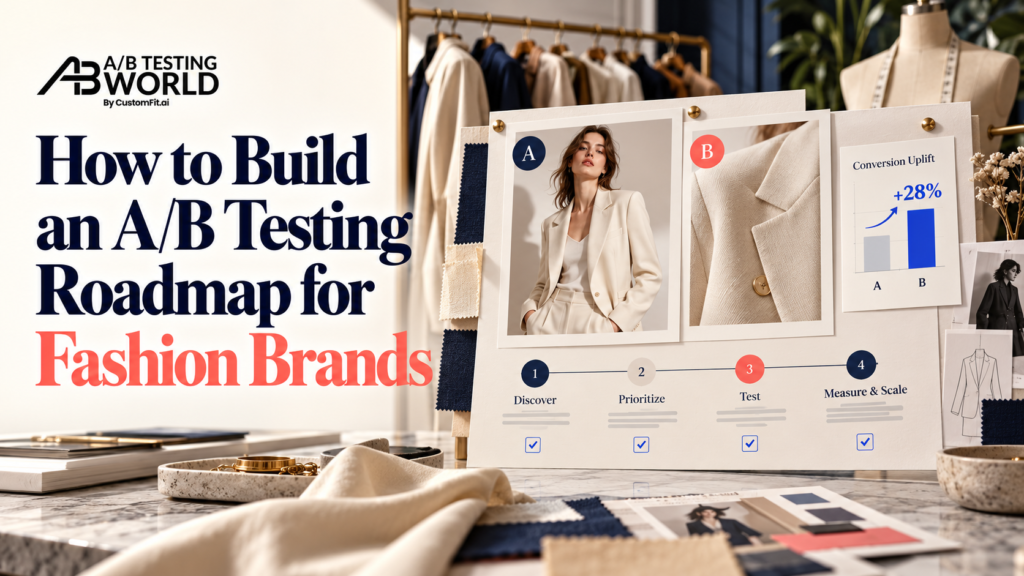
A testing roadmap is a written plan: what you’ll test, in what order, for how long and what you expect to learn. It sounds like paperwork, but it solves a real problem. Without one, teams test whatever someone suggested last week, run tests that can’t finish and forget what they found.
Fashion brands need a roadmap more than most. The catalog changes every season, traffic comes in waves around drops and sales, and returns affect profit long after the order. This guide shows how to build a roadmap step by step, with the numbers and the reasoning behind each choice.
Step 1: Pick one main metric and a few guardrails
Start with what you’re trying to improve. Most fashion brands choose one of these:
- Conversion rate: orders divided by sessions (or visitors). Simple and fast, but ignores order size and returns.
- Revenue per visitor: total revenue divided by visitors. Combines conversion and order value.
- Net revenue per visitor: the same, after refunds and returns. Closer to profit, but slower to measure, since returns arrive days or weeks later.
Pick one as your main metric. Then add guardrails: metrics that must not get worse. For fashion, good guardrails are return rate, average order value, page load time and (if you use it) customer service contacts.
Why one main metric? Because if you judge each test on whatever looks best, you will find a winner by luck. Choosing in advance keeps the test honest.
Step 2: Map your funnel and find the leaks
Before you collect ideas, find out where visitors leave. A typical fashion funnel looks like this:
- Landing page or category page
- Product page
- Add to cart
- Cart
- Checkout
- Order
- Return or keep
Calculate the step-to-step rate for each stage, and split by device and by new vs. returning visitors. You’ll usually see one or two stages where the drop is larger than elsewhere, or where mobile is far worse than desktop. Those are your priority areas.
A caution: don’t read too much into a single week of funnel data. Look at several weeks, and check whether a sale or drop distorted the numbers.
Step 3: Collect ideas from evidence
Ideas should come from observed problems, not opinions. Useful sources for a fashion store:
- Return reasons. If “too small” is the top reason, sizing information is a candidate.
- Customer service questions. What do people ask before buying?
- Reviews. Comments about fit, fabric and color accuracy point to missing information.
- Site search terms. Searches with no results show gaps in your catalog or labeling.
- Session recordings and heatmaps. Where do shoppers hesitate, scroll back or tap and nothing happens?
- Past tests. What did you learn, and what follow-ups did it suggest?
Write each idea as a hypothesis with three parts: the change, the expected effect and the reason. For example: “If we show fit notes next to the size selector, fewer shoppers will abandon on the product page, because return reasons show that fit uncertainty is the main worry.”
Step 4: Check which ideas you can actually test
This is the step most roadmaps skip, and it is where many of them fail. Each idea needs enough traffic to produce a readable result.
The sample size depends on your baseline rate and the size of effect you want to detect. At a 5% false positive rate and 80% power, these are approximate requirements per variant:
| Baseline rate | Detect a 10% relative lift | Detect a 20% relative lift |
| 2% | about 80,700 visitors | about 21,100 |
| 3% | about 53,200 | about 13,900 |
| 5% | about 31,200 | about 8,200 |
Now compare with your own traffic. If a page gets 20,000 visitors a month and your baseline is 3%, a test for a 10% relative lift would need around five months. That’s not practical.
You have a few options when traffic is limited:
- Test a bigger change. Large effects need smaller samples.
- Test earlier in the funnel. Add to cart rate is higher than purchase rate, so the sample needed is smaller. Just be careful that add to cart gains turn into orders.
- Test on templates and categories, not single products, so traffic pools together.
- Test on your highest-traffic pages first. Homepage, top categories and best-selling product pages.
- Accept more uncertainty or use a Bayesian approach, and be honest about it.
Mark each idea in the roadmap with the estimated time to reach the required sample. Drop or reshape any idea that can’t finish in a reasonable time.
Turn Your Backlog Into Live Tests
Set up the first test from your roadmap on your own fashion store. Use every CustomFit.ai feature free for 14 days.
Step 5: Score and rank
You’ll have more ideas than you can run. A simple scoring system helps you choose. One common version scores each idea from 1 to 5 on:
- Impact: how much could it move the main metric?
- Confidence: how strong is the evidence?
- Ease: how little work is it to build and launch?
Add the three scores, or multiply them, and sort. Here’s an example backlog:
| Idea | Impact | Confidence | Ease | Score | Time to sample |
| Fit notes beside size selector | 4 | 4 | 5 | 13 | 3 weeks |
| More on-body photos per product | 4 | 3 | 3 | 10 | 4 weeks |
| Size guide link placement | 3 | 4 | 5 | 12 | 3 weeks |
| Filter order on category pages | 3 | 3 | 4 | 10 | 2 weeks |
| Free returns message near price | 3 | 3 | 5 | 11 | 3 weeks |
| Checkout field reduction | 4 | 4 | 3 | 11 | 4 weeks |
The scores are rough. Their purpose is to start a sensible discussion, not to give a precise answer. Adjust when you learn more, and take “time to sample” into account alongside the score.
Read more: Landing Page A/B Testing: Key Elements to Experiment With
Step 6: Build the calendar around your business
Fashion has a rhythm: new drops, seasonal sales, holiday peaks, end-of-season clearance. Put those on the calendar first, then schedule tests around them.
A few scheduling rules:
- Don’t let tests straddle a major change in traffic. A launch, a sale start or a big campaign changes who’s visiting. Either finish before it or start after it.
- Use quiet periods for larger tests. The weeks between drops are usually more stable.
- Finish important tests before a peak, so proven improvements are live when traffic is highest.
- Run tests for full weeks. Weekday and weekend behavior differs.
- Limit overlapping tests. Two tests on the same page, or on pages in the same flow, can interact and muddy both results. If you run them together, keep them on separate parts of the funnel.
A calendar can be as simple as a table with weeks across the top and tests down the side, plus a row for drops, sales and campaigns.
Step 7: Write the test plan before launch
Every test should have a one-page plan, filled out before it starts:
- Hypothesis (change, effect, reason)
- Pages and audience included
- Main metric and guardrails
- Baseline and the smallest lift worth detecting
- Required sample size and planned end date
- How visitors are assigned (randomization unit)
- Checks to run (sample ratio, device rendering, tracking)
- How you’ll decide, including what you’ll do if the result is flat
Writing the decision rule in advance prevents the temptation to reinterpret results afterward.
Step 8: Run the checks
Before launch and during the test:
- Check each variant on real phones. Most fashion traffic is mobile.
- Confirm tracking. Make sure each event fires correctly for each variant.
- Check for sample ratio mismatch. If your split is 50/50, the visitor counts should be close. A large difference suggests a technical problem.
- Check page speed. A slower variant is also a test of speed.
- Watch for outside events. A viral post or a stock-out can distort a test. Note them.
Step 9: Read the result carefully
When the test ends, look at:
- The primary metric, with its confidence or credible interval, not only the point estimate
- Guardrails, especially return rate (after enough time has passed for returns to come in)
- Whether the effect is consistent across devices and traffic sources (as a hint, not as a conclusion)
- Whether anything unusual happened during the test
Expect plenty of flat results. In most programs, a large share of tests show no meaningful difference. That is useful information, because it stops you from spending time on changes that don’t matter. A winner is a hypothesis that survived one test, so re-check important ones later.
Step 10: Keep a log
For every test, store the plan, the result and what you decided. Include losers and flat results. Fields to record:
- Test name and dates
- Hypothesis
- Pages, audience and device mix
- Primary metric and result with interval
- Guardrail results
- Decision and next idea
- Notes on anything odd
Over a year, the log becomes the most useful document in the program. It tells you what your customers respond to, prevents repeat tests and helps new team members get up to speed.
A sample 90-day plan
Weeks 1 to 2: foundation. Define the main metric and guardrails. Verify tracking, including returns data. Map the funnel. Build the first backlog.
Weeks 3 to 6: first round. Run one or two tests on the biggest leak, on pages with enough traffic. Check sample ratio and mobile rendering at launch.
Weeks 7 to 10: second round. Use what you learned. Move to the next leak. Add returns analysis for round-one tests.
Weeks 11 to 13: review. Update the log, re-score the backlog, plan the next quarter around your calendar of drops and sales.
Resist the urge to plan a whole year in detail. Results from the first quarter will change your priorities.
Start Round One of Your Roadmap
Run the first test on your list with a clear plan. Try CustomFit.ai free for 14 days, cancel anytime.
Common roadmap problems
- Ideas ranked without checking traffic
- A different main metric for each test
- No guardrails for returns
- Tests scheduled across a drop or sale
- Overlapping tests on the same page
- No record of finished tests
Summary
A good fashion testing roadmap rests on a few things: one main metric with guardrails, ideas based on evidence, a sample size check for every idea, a calendar built around drops and sales, a written plan before each test and a log afterward. None of it is complicated. It just has to be done before launch, and kept up.
FAQs
How many tests can a fashion brand run in a year?
It depends on traffic. A store with high traffic might finish one test every two to three weeks on a given funnel stage. Lower-traffic stores may finish only a handful per year, so choosing high-impact ideas matters more.
What should be the main metric in a fashion roadmap?
Many teams use revenue per visitor, and some prefer net revenue per visitor to account for returns. Whatever you choose, keep the return rate as a guardrail and stay consistent across tests.
What if I don’t have enough traffic for a test?
Test a larger change, test earlier in the funnel, pool traffic across a category template or test on your highest-traffic pages. If none of these work, gather qualitative evidence (reviews, recordings, support questions) and make the change without a test.
Should I run several tests at the same time?
Yes, if they’re on different parts of the funnel and traffic allows. Avoid running two tests on the same page, since the changes can interact and make results hard to read.