
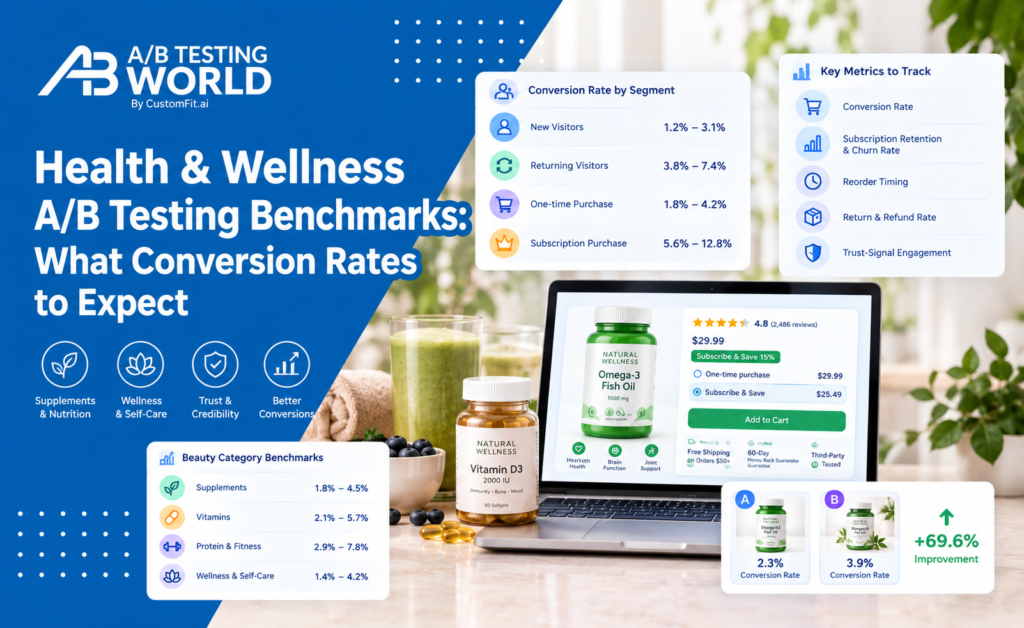
Supplement and wellness brands ask the benchmark question constantly — what conversion rate should we actually expect — and the honest answer is that health wellness ecommerce conversion benchmarks are shaped by a trust barrier unlike almost any other category. A shopper isn’t just deciding whether they like a product; they’re deciding whether to put something in their body based on claims from a brand they may not have heard of before. That skepticism shows up directly in the numbers, and it makes generic ecommerce benchmarks a particularly poor fit for this category.
Why wellness benchmarks need their own context
Health and supplement purchases carry regulatory and credibility baggage that most ecommerce categories don’t. Shoppers have learned, often from direct experience, that wellness claims range from well-substantiated to essentially marketing fiction, and that skepticism applies by default to any new or unfamiliar brand until proven otherwise. This means a wellness brand’s conversion rate is unusually sensitive to how well it establishes credibility — more so than how polished its design is.
Supplement store conversion rate: what drives the range
New customer trust deficit. First-time visitor conversion rates in this category tend to run notably below returning customer rates, driven by the specific skepticism wellness claims attract from people who’ve been burned by exaggerated marketing before.
Price and commitment level. A one-time, lower-priced trial product converts differently than a subscription commitment to a higher-priced supplement stack — comparing these as if they’re the same purchase type distorts any benchmark comparison.
Regulatory and claim specificity. Brands that lean on vague, unsubstantiated claims tend to see more skepticism-driven drop-off than brands with specific, verifiable backing (clinical studies, third-party testing, transparent dosing) — this isn’t just an ethical difference, it’s a measurable conversion one.
Wellness brand A/B test benchmarks: using them correctly
1. Compare your own segmented performance over time, not a generic external number. Your new-visitor conversion rate this quarter versus last quarter, with a consistent traffic mix, tells you far more than comparing against a blended “wellness industry average” that was calculated across brands with very different trust positioning and price points.
2. Separate first-purchase conversion from subscription conversion specifically. These are genuinely different decisions with different benchmarks — a shopper converting to a first, one-time purchase is making a smaller commitment than one agreeing to a recurring subscription, and conflating the two in your benchmarking obscures what’s actually happening in each part of your funnel.
3. Treat A/B test lift as more reliable signal than any external benchmark comparison. A measured, controlled lift from testing trust signals or dosage transparency on your own site tells you something concrete. A gap against a generic external number could be explained by dozens of unrelated factors.
Read Also: How Long Should You Run an A/B Test? Best Practices for Reliable Results
Health ecommerce KPI: what to track alongside conversion rate
Conversion rate alone misses a lot of what actually matters in wellness specifically:
- Subscription retention and churn rate, since much of the category’s real economics live in repeat, ongoing purchases rather than one-time sales
- Reorder timing relative to typical product usage cycles, which reveals whether customers are actually using the product as intended or abandoning it early
- Return and refund rate tied to specific claims, which can flag a mismatch between marketing promises and actual product experience
- Trust-signal engagement, such as click-through on certification badges or clinical study references, as a leading indicator of whether your credibility-building content is actually being noticed
Average supplement store conversion rate: a more useful framing
Rather than anchoring to a specific percentage from a generic report, build your own realistic baseline segmented by new versus returning visitors, one-time versus subscription purchase paths, and price tier. Use A/B testing specifically focused on trust and credibility signals — the category’s biggest lever — to move each of those segmented numbers over time, rather than measuring success against an external figure that was never calculated the way your traffic actually breaks down.
Track Your Own Benchmarks, Not Industry Averages
Measure what really moves conversions on your wellness store. Run controlled A/B tests with CustomFit.ai, free for 14 days.
Common mistakes when benchmarking wellness conversion rates
The most common mistake is comparing a blended conversion rate against a generic ecommerce or even generic “health and wellness” benchmark without separating first-purchase from subscription conversion, which are different decisions with different natural rates. The second is underestimating how much the new-customer trust deficit specific to this category depresses first-time visitor numbers relative to returning customers — a gap that’s often larger here than in less skepticism-prone categories, and shouldn’t be mistaken for a site quality problem alone.
The bottom line
Health wellness ecommerce conversion benchmarks are shaped more heavily by category-specific trust dynamics than by typical ecommerce factors like design quality or page speed alone. The most reliable approach is tracking your own segmented performance — by visitor type, purchase type, and price tier — over time, and using controlled A/B testing focused specifically on credibility and trust signals as your primary lever for improvement, rather than chasing a generic external benchmark number.
Build Trust. Lift Conversions.
Test trust and credibility signals on your own store and see what actually works. Try CustomFit.ai free for 14 days, cancel anytime.