
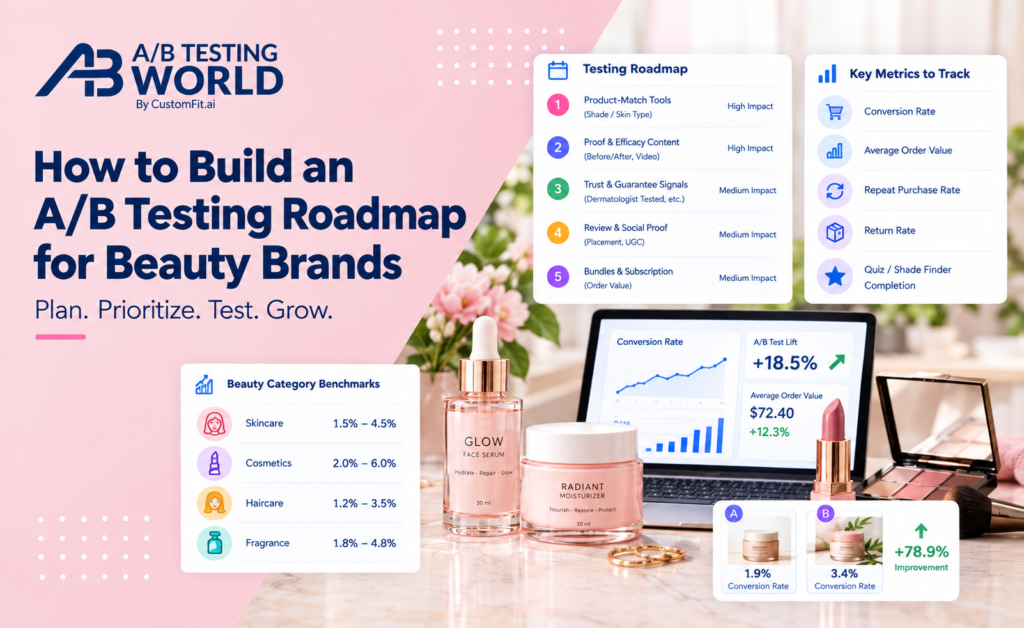
Running individual tests as ideas come up feels productive, but it rarely compounds into real, lasting improvement. A proper A/B testing roadmap beauty brands can actually follow turns scattered test ideas into a deliberate, prioritized sequence — one that builds on itself instead of jumping randomly between unrelated page elements every time someone on the team has a new idea.
Why beauty brands specifically need a structured roadmap
Beauty sits at the intersection of a few things that make unstructured testing especially costly: real category-specific trust barriers, fast-moving trends that can make old winners stale, and often tighter traffic relative to the number of plausible test ideas available (shade variants, formula types, skin concerns) compared to simpler ecommerce categories. Without a deliberate skincare testing strategy plan, it’s easy to burn testing bandwidth on low-impact experiments while the highest-leverage friction points go untouched indefinitely.
Step 1: Audit your funnel for category-specific friction first
Before building a test list, map out where beauty-specific hesitation is most likely occurring in your funnel — shade or skin-type matching, ingredient trust, proof of efficacy, subscription framing for consumables. This audit should come before a generic CRO checklist, since the highest-impact opportunities in beauty are usually category-specific, not generic.
Step 2: Prioritize using both impact and traffic feasibility
A beauty CRO roadmap needs to weigh two things for every candidate test: how much it’s likely to matter (does it address a real, significant point of hesitation) and whether you have enough traffic to reach a reliable result in a reasonable timeframe. A high-impact test on a low-traffic page may need to wait, or be restructured to need less traffic, before it’s worth running.
A simple framework that works well here:
- High impact, enough traffic: test immediately
- High impact, insufficient traffic: consider Bayesian testing approaches, or consolidate test scope to concentrate traffic
- Lower impact, enough traffic: worth testing, but sequenced after higher-impact tests
- Lower impact, insufficient traffic: deprioritize until circumstances change
Step 3: Sequence tests to build on each other, not compete for attention
Cosmetics experimentation planning works best when tests are sequenced rather than run simultaneously on overlapping elements. Fixing core product-match confidence (shade tools, skin-type guidance) before testing subscription framing or bundle offers makes sense, since a shopper who isn’t confident the product is right for them won’t be meaningfully swayed by a better bundle deal layered on top of that unresolved uncertainty.
A reasonable default sequence for most beauty brands:
- Product-match confidence tools (shade finders, skin-type quizzes, fit guidance)
- Proof-of-efficacy content (before/after imagery, video demonstration)
- Trust and guarantee signals specific to the category
- Review and social proof placement
- Order value levers (bundles, subscription framing, sample add-ons)
Read Also: Landing Page A/B Testing: Key Elements to Experiment With
Step 4: Build in regular re-testing, not just new tests
Beauty brand test prioritization shouldn’t treat a past winning test as permanently settled. Given how quickly trends, ingredient preferences, and even shade-matching technology expectations shift in this category, build periodic re-testing of major page elements into your ongoing roadmap — not as an afterthought, but as a standing part of the plan from the start.
Track Your Own Beauty Benchmarks
Skip the generic industry averages. Run controlled A/B tests on your own traffic with CustomFit.ai, free for 14 days.
Step 5: Document hypotheses and results as you go
A roadmap without documentation loses its value over time — new team members repeat tests that have already been run, and institutional knowledge about why a particular page element looks the way it does gets lost. For each test, record the hypothesis, the specific change, the result, and the reasoning behind any decision made from it. This becomes genuinely valuable as your testing program matures and the number of past experiments grows.
Step 6: Set a realistic testing cadence based on your actual traffic
Not every beauty brand has enough traffic to run tests weekly with full statistical confidence. Be honest about your realistic testing velocity — a lower-traffic brand running fewer, higher-impact, longer-duration tests will get more reliable value than one attempting an aggressive cadence that consistently produces underpowered, inconclusive results.
Common mistakes when building a beauty testing roadmap
The most common mistake is building a roadmap purely around ease of implementation rather than actual expected impact — testing whatever’s quickest to set up, rather than what’s most likely to move the needle on the trust and product-match friction specific to this category. The second is treating the roadmap as a fixed, one-time plan rather than a living document that gets revisited as results come in and new priorities emerge.
The bottom line
A real A/B testing roadmap beauty brands benefit from isn’t just a list of test ideas — it’s a deliberate sequence that prioritizes category-specific friction first, respects realistic traffic constraints, and builds in regular re-testing as trends shift. Brands that build this kind of structure consistently get more value from their testing program than ones running isolated, unconnected experiments whenever an idea happens to come up.
Measure Real Progress, Not Averages
Use controlled A/B tests to lift conversions on your own beauty store. Try CustomFit.ai free for 14 days, cancel anytime.