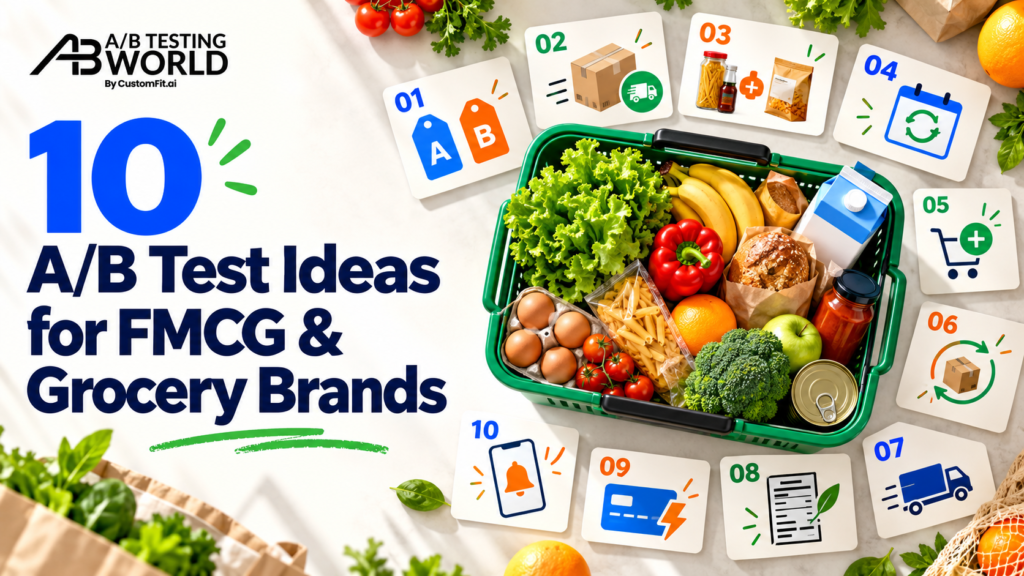
Testing everyday products is different from testing a $300 jacket. Prices are low, margins are thin, shipping can cost more than the profit on an order and the real value is in customers coming back. A test that lifts first-order conversion but loses money per order is a bad trade.
The ten ideas below are written with that in mind. Each has a hypothesis, the metrics to watch and the main risk. At the end, there’s a short note on sample size, because it decides whether a test is worth running at all.
Before you start: set up the measurement
Two decisions come before any idea.
Choose a main metric. For FMCG, revenue per visitor or margin per visitor is usually a better main metric than conversion rate, because order size matters so much. Track conversion rate and average order value as supporting lines so you can see which one moved.
Choose guardrails. Metrics that must not get worse: margin per order, shipping cost per order, return or refund rate and page load time.
Also decide how visitors are assigned. Use a persistent visitor-level assignment, so the same shopper doesn’t see different versions on different visits. This matters more here than in most categories, because FMCG shoppers visit often.
1. Free shipping threshold
Hypothesis: A free shipping threshold set slightly above your current average order value will push more shoppers to add items, raising order value without lowering conversion much.
What to test: Different thresholds (for example, one near current AOV vs. 20% above it), plus a progress message in the cart (“Add $6 more for free shipping”).
Metrics: Revenue per visitor and average order value as primary. Watch conversion rate, items per order and shipping cost per order.
Risk: If the threshold is too high, shoppers abandon rather than add. If too low, you lose margin on shipping. Look at the distribution of cart values, not only the average, to see how many carts sit just below the line.
2. Multipacks and bundles
Hypothesis: Showing a larger pack next to the single item, with the per-unit saving, will move some shoppers to the larger pack and raise revenue per order.
What to test: A pack selector with the largest pack pre-selected vs. the single unit pre-selected. Savings shown per unit vs. as a percentage vs. as a currency amount.
Metrics: Items per order, average order value and revenue per visitor. Watch margin per order, since larger packs often carry lower unit margins.
Risk: A pre-selected large pack can raise returns or complaints if shoppers didn’t mean to buy it. Check refund rate and customer contacts.
3. Subscribe-and-save presentation
Hypothesis: Making the subscription option clearer will increase the share of subscribers without hurting first-order conversion.
What to test: The default selection (one-time vs. subscribe), how the discount is shown (percentage vs. currency), the delivery frequency options (a default vs. a choice) and the cancellation message (“skip or cancel anytime,” if true).
Metrics: Subscription share of orders, first-order conversion and, most important, retention after 2 to 4 deliveries.
Risk: A subscription default can produce signups from people who didn’t notice, followed by quick cancellations and chargebacks. A test that wins on signups and loses on retention hasn’t won. Measure retention before making the decision, which means the test result isn’t complete at the end of the test period.
4. Add to cart on category pages
Hypothesis: Many repeat shoppers know what they want. A visible add to cart button and quantity control on the category page will cut the steps to purchase.
What to test: Quick add with a quantity selector vs. click-through to the product page.
Metrics: Add to cart rate per session, items per order and conversion rate.
Risk: Shoppers who skip the product page miss ingredient information, allergens and reviews. That could lead to returns. Check if contact messages or refund requests go up. Also make variant selection. Like flavor or size. Is easy to see and clear in the quick add option.
Read more: A/B Testing vs. Multivariate Testing: Which One Should You Use?
5. Delivery date and stock messages
Hypothesis: Showing an estimated delivery date and clear stock status on the product page will help reduce cart abandonment. Now people might leave because they’re unsure when their order will arrive.
What to test: Try putting an estimated delivery date near the add to cart button. Compare that to showing it at checkout. Also test stock messages: “In stock ” “Low stock,” or “Ships in 2 days.”
Metrics: Watch the add, to cart rate, checkout completion rate and how many people cancel after starting checkout.
Risk: Don’t promise what you can’t deliver. If the delivery date is wrong people will. More might return items. Make sure the delivery estimate uses accurate data. Low stock messages must be true. Don’t say ” stock” if there’s plenty.
Test Basket-Building Ideas on Your Store
Try shipping thresholds, pack selectors and cart add-ons without writing code. Use every CustomFit.ai feature free for 14 days.
6. “Buy Again” feature and reorder short-cut
Assumption: Showing returning customers a vivid “buy again” button will improve repeat purchase rate and speed of ordering process.
Things to check: If having a reorder module on homepage or account page for returning customers will show past orders with the one click feature of adding to the shopping cart against not having the module.
Metrics: Repeat purchase rate within a set window (for example, 60 days), days between orders and revenue per returning visitor.
Risk: The effect shows up over weeks, not days, so the test needs a long enough window to catch it. Analyze returning customers separately from new ones, and make sure assignment is stable across visits.
7. Product page ingredient and nutrition information
Hypothesis: Putting key facts (ingredients, allergens, nutrition highlights, certifications) near the price will answer common questions before shoppers leave.
What to test: A short fact block near the add to cart button vs. details in a tab further down.
Metrics: Add to cart rate, conversion rate and customer service contacts about product information.
Risk: Claims. Any statement about health, content or certification must be accurate and allowed where you sell. Review copy before testing.
8. Cart add-ons
Hypothesis: Offering one relevant low-priced add-on in the cart will raise order value with little effect on conversion.
What to test: One add-on suggestion vs. none, or related items vs. best sellers. Place it above the checkout button vs. further up.
Metrics: Average order value, attach rate (share of orders with an add-on), conversion rate and margin per order.
Risk: Too many suggestions can distract from checkout. Keep it to one or two, and check that conversion doesn’t fall.
9. Express payment and guest checkout
Hypothesis: Lower-friction checkout will raise conversion on small, low-consideration orders, where a long form feels out of proportion to the purchase.
What to test: Express payment buttons (wallet payments) placed above the standard checkout button vs. below, and clear guest checkout vs. a prompt to create an account.
Metrics: Checkout completion rate, conversion rate and the share of orders by payment method.
Risk: Express flows can skip cart add-ons and discount fields, so check average order value by payment type. Data from Baymard’s US study shows 18% of shoppers abandon when forced to create an account, and 9% cite too few payment methods, so the potential is real, but measure your own effect.
10. Reminder messages for replenishment
Hypothesis: Contacting customers when they’re likely to run out will raise repeat purchase rate.
What to test: A reminder message timed to the typical gap between orders for a product (for example, at 80% of the average gap) vs. a fixed schedule vs. no reminder (a holdout group).
Metrics: Reorder rate within the window, revenue per customer over 90 days and unsubscribe rate.
Risk: Needs a proper holdout group, since many customers would have reordered anyway. Without one, you’ll credit the reminder with sales it didn’t cause. Watch unsubscribes and complaints.
How much traffic do these tests need?
Sample size decides whether an idea is testable. At a 5% false positive rate and 80% power, here are rough numbers per variant for conversion-style metrics:
| Baseline | Detect 10% relative lift | Detect 20% relative lift |
| 2% | about 80,700 | about 21,100 |
| 3% | about 53,200 | about 13,900 |
| 5% | about 31,200 | about 8,200 |
A few practical notes:
- Revenue metrics need more data than conversion metrics, because order values vary a lot. Cap extreme orders at a high percentile and say so.
- Metrics that depend on time, such as repeat purchase, need both traffic and patience. The test has to run long enough for customers to come back.
- Test on templates and categories, so traffic from many products is pooled.
- Test earlier steps (add to cart) if purchase-level samples are out of reach, then confirm the change carries through to orders.
Running the tests properly
A short list that applies to all ten:
- Run variants at the same time, with random assignment per visitor.
- Run at least two full weeks, and longer if the metric needs time.
- Check for sample ratio mismatch before reading results.
- Avoid ending tests during big promotions, or analyze those periods separately.
- Look at confidence intervals, not just the point estimate.
- Record the result, including flat ones.
Pick One Idea and Start Testing
Begin with the free shipping threshold or the pack selector. Try CustomFit.ai free for 14 days, cancel anytime.
Where to start
If you can only run one or two tests this quarter, the free shipping threshold (#1) and the pack selector (#2) are the best starting points. They act directly on order value, which matters most when each order is small, and they need no new tools. Cart add-ons (#8) and express checkout (#9) come next.
Summary
For FMCG, a good test idea doesn’t only raise conversion. It improves revenue or margin per visitor and holds up over repeat purchases. Choose your main metric and guardrails first, check the sample size second and only then pick the idea.
FAQs
What should an FMCG store test first?
The free shipping threshold and the pack or bundle selector. Both act on order value, which matters because margins are thin and shipping costs are fixed per order.
How do I test repeat purchases?
Use a stable visitor-level assignment, define a time window (such as 60 or 90 days) and compare reorder rates between groups. Use a holdout group for reminders, so you can tell what the reminder caused.
Is conversion rate the right main metric for grocery stores?
Often not. Revenue per visitor or margin per visitor includes order size, which matters more for low-priced products. Keep conversion rate as a supporting metric.
How long should a test run?
Until it reaches the planned sample size and at least two full weeks. Tests on repeat behavior need longer, since customers take time to come back.