
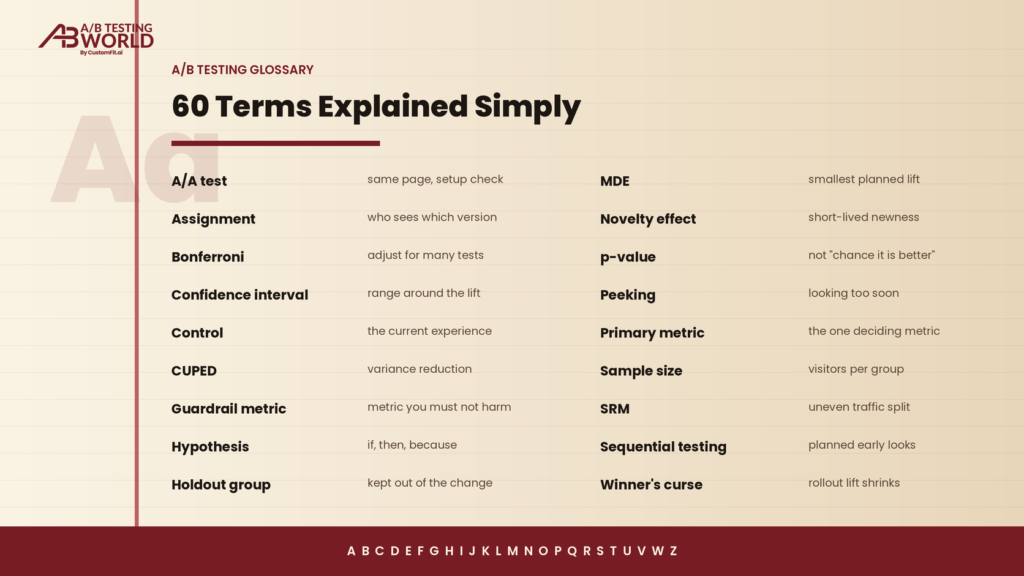
If you are new to experiments, start with our beginner guide to A/B testing, then use this AB testing glossary as the lookup page you keep open while you plan and read tests. It explains 60 a b testing terms in one line each.
This page is an experimentation glossary for people who run tests on ecommerce sites, not a general cro glossary of every marketing phrase. Deeper guides on this site are linked after the table.
Use it to align a team on ab testing terminology so “significance,” “power” and “guardrail” mean the same thing in every doc.
AB Testing Glossary: 60 Terms
Each entry is a working definition, not a tutorial.
| Term | Meaning |
| A/A test | A test where both groups see the same experience, used to check the split, tracking and false-positive rate. |
| A/B test | A controlled experiment that splits visitors between a control and a changed variant to measure a pre-registered metric. |
| A/B/n test | An A/B test with more than one variant, such as A/B/C, which needs more traffic and a multiple-comparisons plan. |
| Assignment | The rule that puts each visitor into control or variant. It should be random and persist on later visits. |
| Average order value (AOV) | Revenue divided by the number of orders. Often a guardrail, because it ignores visitors who do not buy. |
| Baseline conversion rate | The current rate of the primary metric in the control, used to plan sample size and MDE. |
| Bayesian testing | An analysis style that updates a probability distribution for the lift as data arrive, rather than using only a p-value. |
| Bonferroni correction | An adjustment for multiple comparisons: divide the significance level by the number of tests to reduce false winners. |
| Carryover effect | Residual impact from a previous test that still affects a visitor in a later experiment and can bias results. |
| Chi-square test | A statistical test for counts, such as a traffic split against a planned 50/50 ratio or two conversion counts. |
| Confidence interval | A range around the estimated lift that would contain the true effect in a stated share of repeated experiments, often 95%. |
| Confidence level | The complement of the significance level, often 95%. It describes the procedure, not the chance that one variant is better. |
| Control | The current experience in an A/B test. All comparisons are made against this version, not last week’s sitewide baseline. |
| Conversion rate | The share of assigned visitors who complete the primary action, such as a purchase. Define the numerator and denominator. |
| CUPED | A variance reduction method that uses pre-experiment data, such as prior spend, so the same lift is easier to detect. |
| Early stopping | Ending a test before the planned sample because the numbers look good or bad. Unplanned stops inflate false positives. |
| Experiment log | A written record of each test’s hypothesis, setup, result and decision, so the team does not rerun forgotten work. |
| False negative | A Type II error: the test misses a real effect, often because the sample was too small for the planned MDE. |
| False positive | A Type I error: the test flags a difference that is only chance, which happens in about 1 in 20 tests at a 0.05 level. |
| Flicker effect | A brief flash of the control before the variant loads, which can change behavior and bias a client-side test. |
| Frequentist testing | The classic approach that uses a null hypothesis, a pre-set significance level and a p-value or confidence interval. |
| Guardrail metric | A metric you do not want to harm, such as refund rate or revenue per visitor, even if the primary metric improves. |
| Holdout group | A slice of traffic kept out of one test, or out of a set of winning changes, to measure longer-term incrementality. |
| Hypothesis | A testable statement: if we change X, then metric Y will move, because Z. Write it before launch. |
| Inconclusive result | A finished test with no clear difference. It may mean there is no useful effect, or that the test was underpowered. |
| Interaction effect | When the effect of one test depends on another test or a segment, so the combined result is not a simple sum. |
| Lift (uplift) | The relative or absolute change in a metric, usually (variant minus control) divided by control. Say which you are reporting. |
| Minimum detectable effect (MDE) | The smallest lift you sized the test to detect at the planned power and significance level. |
| Multiple comparisons | The extra false-positive risk created by looking at many variants, metrics or segments. It needs a plan or an adjustment. |
| Multivariate test | A test that changes several elements at once and tries to estimate each effect, which usually needs much more traffic. |
| Mutually exclusive experiments | Tests set up so a visitor can be in only one of them at a time, used when you expect an interaction. |
| Novelty effect | A short-lived behavior change caused by the newness of a variant, which can fade after people get used to it. |
| Null hypothesis | The default claim in a frequentist test, usually that control and variant have the same true metric value. |
| One-sided test | A test that only looks for a change in one direction. Use it only if a decline would be treated as no difference. |
| Overall evaluation criterion (OEC) | The single primary metric, or a planned combination of metrics, that decides whether a test ships. |
| p-value | The probability of seeing a result at least this extreme if the null hypothesis were true, not the chance the variant is better. |
| Peeking | Checking results repeatedly and stopping when a number looks significant, which inflates false positives unless the design allows it. |
| Practical significance | A lift large enough to matter to the business. A tiny but statistically significant lift may not be worth shipping. |
| Primacy effect | A lasting preference for the first version a user saw, which can work against a new variant among existing customers. |
| Primary metric | The one metric the test is designed to move, chosen before launch. Everything else is secondary or a guardrail. |
| Randomization | The process that gives each eligible visitor a known chance of seeing each version, which makes the groups comparable. |
| Revenue per visitor (RPV) | Total revenue divided by assigned visitors, including those who did not buy. Often a better primary metric for offer tests. |
| Sample size | The number of visitors needed in each group to detect the planned MDE at the chosen power and significance level. |
| Sample ratio mismatch (SRM) | A statistically uneven split compared with the planned ratio, usually a sign of a tracking or assignment bug. |
| Segmentation | Cutting results by a planned group such as device. Useful for mix checks, risky if you hunt for winners later. |
| Sequential testing | A design that allows planned looks at the data, with stopping rules that keep the false-positive rate under control. |
| Significance level (alpha) | The false-positive rate you accept, commonly 0.05. Set it before the test, not after you see the p-value. |
| Simpson’s paradox | A reversal where a variant wins in each segment but loses overall, or the reverse, usually because of an uneven traffic mix. |
| Statistical power | The chance of detecting a real effect of a given size, often planned at 80%. Low power produces inconclusive tests. |
| Statistical significance | A result whose p-value is below the pre-set significance level. It is not the same as a big or lasting improvement. |
| Sticky assignment | An assignment rule that keeps a returning visitor in the same group, usually with a cookie or a server-side bucket. |
| Stratification | Forcing the planned split inside important segments, such as mobile and desktop, so the traffic mix stays balanced. |
| t-test | A statistical test used to compare means, such as revenue per visitor, especially with smaller samples or unknown variance. |
| Traffic allocation | The planned share of visitors sent to each version, such as 50/50 or 80/20. Check the observed share for SRM. |
| Two-sided test | A test that looks for a difference in either direction. This is the default for most ecommerce A/B tests. |
| Variant (treatment) | The changed experience being tested against the control. One test should usually change one meaningful thing. |
| Variance | How spread out a metric is across visitors. High variance, common in revenue data, means you need a larger sample. |
| Variance reduction | Techniques, including CUPED and better metric design, that lower variance so a test can detect the same lift with fewer visitors. |
| Winner’s curse | The tendency for a winning test’s observed lift to shrink at rollout, because the original result was partly luck. |
| z-test | A statistical test used to compare proportions, such as two conversion rates, when samples are large enough. |
That is the full set of 60 terms. If you are writing an internal style guide, copy the definitions you use every week and leave the rest as reference.
For longer explainers of the same ideas, see our guides to the p-value in A/B testing, sample ratio mismatch and the A/B test sample size formula.
Read more: How to Set Up a Winning A/B Test
Put the Terms Into Practice
Run your next experiment with a clear hypothesis, a planned sample size and honest significance checks, without writing code. Try CustomFit.ai free for 14 days.
A/B Testing Terminology Your Team Should Standardize
A shared list of ab testing terminology prevents two expensive mistakes: calling a mid-test p-value of 0.04 a “win,” and treating a guardrail as the primary metric. Agree in writing on one primary metric and a short list of guardrails, a default significance level and power (many teams use 0.05 and 80%), two-sided tests unless you write an exception, no end-date changes from peeking, and a split check (SRM) before anyone reads the lift.
If you want a calculator for the sample size term above, customfit.ai maintains an A/B test sample size calculator you can use alongside this glossary.
Experimentation Glossary or CRO Glossary?
People sometimes search for an experimentation glossary and a cro glossary as if they were the same page. Conversion rate optimization covers research, UX, offers and analytics. Experimentation is the subset that uses controlled tests to estimate causal effects. This page stays in that subset and defines the terms that decide whether a test is trustworthy.
Pick One Idea and Start Testing
Use the terms above to write a clear hypothesis and launch your next test. Try CustomFit.ai free for 14 days, no credit card required.
Summary
This ab testing glossary collects 60 a b testing terms in one place, from A/A tests through p-values, sample ratio mismatch and the winner’s curse. Use it as a shared experimentation glossary for planning and results reviews, not as a general cro glossary. Standardize the terms that affect decisions, and follow the deeper guides on this site when a one-line definition is not enough.
FAQs
What is an A/B testing glossary used for?
An ab testing glossary gives a team a shared meaning for terms such as p-value, MDE, guardrail and sample ratio mismatch. Use it when you write a test plan or review results, so those words are not redefined in every meeting.
How is A/B testing terminology different from general marketing language?
A/B testing terminology is about causal measurement: assignment, control, variant, significance, power and related ideas. Marketing language describes offers, audiences and creative. You need both, but mixing them is how a “winning campaign” gets confused with a winning experiment.
Which A/B testing terms should a new team learn first?
Start with hypothesis, control, variant, primary metric, guardrail, sample size, p-value, statistical significance, confidence interval and sample ratio mismatch. Those ten terms cover planning, launch checks and the decision at the end of a test.
What belongs in an experimentation glossary that would not be in a CRO glossary?
Terms such as CUPED, peeking, sequential testing, Bonferroni correction, holdout groups and Simpson’s paradox belong here because they affect whether a test result can be trusted. A broader CRO glossary would also cover research methods, UX patterns and merchandising ideas.
Is a one-line definition enough to run a test?
No. A one-line definition is enough to keep a meeting precise. For sample size, peeking, CUPED or inconclusive results, use the longer guides linked after the table, and write a test plan before you launch.
Should I invent new terms for my company’s testing process?
Only when the standard term is missing. If you already have a word for sample ratio mismatch or a guardrail metric, use it. New names for the same idea make it harder to hire, to brief an agency, and to compare notes with published methods.