Most teams do not fail at A/B testing because they have too few ideas. They fail because they run the loudest idea first. The pxl prioritization framework was built to stop that habit. Instead of asking people to rate “impact” out of 10, it asks yes or no questions about evidence, noticeability and effort.
This post explains the pxl framework, compares it with the ice framework for prioritization and the pie framework cro teams still use, and scores the same five ecommerce ideas all three ways so you can see where the models disagree.
If you want a place to store the scores, use a simple backlog table. Our A/B test hypothesis template is a good source for the ideas you will rank.
What the PXL Prioritization Framework Is
The pxl prioritization framework comes from CXL (Peep Laja and team). The original write-up, PXL: A Better Way to Prioritize Your A/B Tests, is still the best primary source. The design goal is simple: make the score hard to inflate.
Most questions are answered with 1 or 0. A few are weighted because they tend to matter more. Ease is scored by a time bracket, not by a vague “easy or hard” feeling. CXL’s published criteria, with the usual weights, look like this.
| Criterion | Score if yes | Score if no |
| The change is above the fold | 1 | 0 |
| The change is noticeable in under 5 seconds | 2 | 0 |
| The change adds or removes an element | 2 | 0 |
| The change is meant to increase user motivation | 1 | 0 |
| The test runs on a high-traffic page | 1 | 0 |
| It addresses an issue found in user testing | 1 | 0 |
| It addresses an issue found in qualitative feedback (surveys, interviews, support) | 1 | 0 |
| It addresses an insight from digital analytics | 1 | 0 |
| It is supported by heatmaps, click maps or eye tracking | 1 | 0 |
| Ease of build | 3 if under 4 hours, 2 if up to 8 hours, 1 if under 2 days, 0 if longer |
The maximum total is 14. A hunch on a low-traffic page can score close to zero even if someone on the team “feels” it is a 9 out of 10.
You are supposed to customize it. CXL says so in the same article. A jewelry brand might add “does not increase return risk.” A subscription brand might add “does not raise cancel rate.” Keep the new items binary, and write down what “yes” means before you score.
PXL Framework vs ICE and the PIE Framework for CRO
Before PXL, most ab test prioritization conversations used one of two short models.
ICE (Impact, Confidence, Ease) asks each person to score those three words, usually from 1 to 10, then averages them. It is fast, which is why product teams like it. It is also easy to game. “Impact” and “Confidence” are almost always opinions, and Ease is often scored by the person who will not build the test.
PIE (Potential, Importance, Ease) comes from WiderFunnel and is still common in the pie framework cro world. Potential is how much a page can improve, Importance is how valuable that page is, and Ease is how hard the test is to run. It is a better fit than ICE when you are choosing among pages, because Importance forces you to look at traffic and revenue. It still leaves Potential as a soft judgment.
customfit.ai has a full comparison of those two models in PIE vs ICE for prioritization. The useful contrast with PXL is this: ICE and PIE ask you to estimate the size of the prize. PXL asks you whether the idea is visible, backed by evidence, and cheap to ship. That is a different question, and it produces a different ranking.
Five Ecommerce Ideas, Scored Three Ways
To make the difference concrete, we will score the same five ideas all three ways. The ICE and PIE numbers are honest team-style averages of three 1-to-10 ratings, not official answers. The PXL scores follow the table above and total out of 14. Higher is better in every column.
The five ideas:
- 1. Show a delivery date under the price on the product page, because support tickets often ask “when will this arrive?”
- 2. Change the add-to-cart button from black to a brighter green.
- 3. Add a “Complete the look” row under the product description that pairs the viewed item with two frequently co-purchased accessories, because product-page analytics already show a higher average order value when shoppers open a second related SKU.
- 4. Launch a sitewide exit-intent popup that offers 10% off a first order in exchange for an email, with no survey or session-recording evidence behind the 10% figure or the trigger.
- 5. Rewrite the homepage hero headline from a generic “Shop the new collection” line to one that leads with delivery speed, which a homepage survey named as the main reason visitors hesitate.
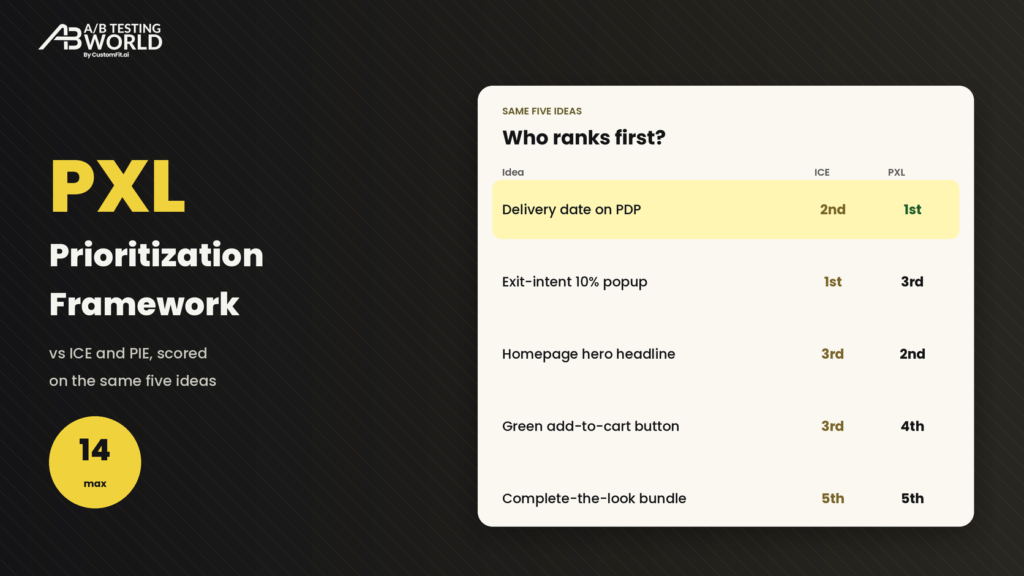
| Idea | ICE (avg) | PIE (avg) | PXL (out of 14) | PXL notes |
| Delivery date under the price | 7.3 | 7.0 | 11 | Above the fold, noticeable, adds an element, high-traffic page, support tickets and analytics, about a day’s work (ease = 2) |
| Green add-to-cart button | 6.7 | 6.3 | 7 | Above the fold and noticeable, high-traffic page, under 4 hours (ease = 3). No research, and it does not add or remove an element |
| “Complete the look” bundle | 5.3 | 6.0 | 5 | Adds an element on a high-traffic page, with some analytics on average order value, but it sits below the fold and needs merchandising (ease = 0) |
| Exit-intent 10% popup | 7.7 | 7.3 | 9 | Noticeable, adds an element, sitewide traffic, quick to launch. No research behind the 10% offer |
| Homepage hero headline | 6.7 | 6.7 | 9 | Above the fold, noticeable, high traffic, a homepage survey supports a rewrite, and it can be built in an afternoon |
What to notice:
- ICE ranks the popup first. It “feels” high impact, the team is confident, and it is easy to ship. PXL ranks it third, because none of the evidence questions are a yes.
- The delivery date test, which came from real support tickets and product-page analytics, comes first in PXL and only second in ICE.
- The button color test looks respectable in ICE (the Ease score of 10 pulls the average up) and mid-pack in PXL.
- The bundle, which might be a strong revenue test, scores low in PXL because it is below the fold and slow to build. That is useful information, not a reason to kill it. It may belong later in the quarter, after a faster evidence-backed test.
This is the point of the pxl framework: it changes the order so visible, researched, shippable tests go first.
Read more: What Makes a Good A/B Test? Avoiding Common Mistakes
Test the Ideas You Ranked First
Launch the next experiment on your store with a clear hypothesis, stable assignment and readable results, without writing code. Try CustomFit.ai free for 14 days.
How to Run a PXL Scoring Session
A scoring meeting should be short and slightly uncomfortable, because the evidence questions expose thin ideas.
- 1. Bring the idea, the page and the evidence. A screenshot, a ticket theme, a heatmap or an analytics screenshot. If you have no evidence, the four research scores stay at zero, and that is fine.
- 2. Answer the noticeable-in-five-seconds question with a real check. Show a colleague the control and the variant for five seconds each. If they cannot tell them apart, the score is 0, not 2.
- 3. Let the person who will build the test set the ease bracket. Do not let the person who filed the idea score “under 4 hours” on their behalf.
- 4. Write the total in the backlog and sort. Do not relitigate a 7 versus an 8. Run the top idea that is actually ready.
- 5. Revisit scores only when the evidence changes. A new user test can move an idea up. A design revision that suddenly sits below the fold should move it down.
For a wider planning view, customfit.ai’s experimentation roadmap and prioritization guide sits above this weekly ranking. A clear primary metric still matters more than a perfect score. See our guide to choosing the right metrics for A/B testing.
When PXL Is the Wrong Tool
PXL is a ranking tool for a list of page-level tests. It is a weak tool for other jobs.
- Choosing among business bets. A pricing test, a new market or a checkout rewrite may score badly on ease and still be the right work for the quarter. Do not let a 14-point scale overrule a strategy decision.
- Personalization or audience tests. “Above the fold” and “noticeable in five seconds” assume a single page change. Audience tests need a different rubric.
- Very small catalogs or very low traffic. If you can run only three tests a year, pick the one with the biggest strategic upside, then use PXL only to design a noticeable variant.
- Ideas with a safety risk. A discount popup can score well and still hurt margin. Add a binary guardrail criterion, or reject the idea before it is scored.
PXL also cannot fix a messy process. If you skip hypotheses, peek at results or launch without a sample size plan, a better backlog order will not save the program. Pair the score with how to set up a winning A/B test.
A One-Page Scoring Sheet You Can Copy
| Column | What to enter |
| Idea and page | Short name and template |
| Hypothesis | One sentence |
| The 10 PXL answers | 0, 1, 2 or the ease bracket |
| PXL total | Sum, out of 14 |
| ICE or PIE (optional) | Only if you want a side-by-side view |
| Status | Ranked, next up, running, done |
| Evidence links | Tickets, heatmap, analytics view |
Score five to ten ideas in one sitting, then run the top one. The sheet is a record of why that idea went first.
Pick One Idea and Start Testing
Begin with the highest PXL score that is ready to ship. Try CustomFit.ai free for 14 days, no credit card required.
Summary
The pxl prioritization framework replaces soft 1-to-10 ratings with yes or no questions about visibility, evidence and effort. Compared with the ice framework for prioritization and the pie framework cro teams often start with, PXL is slower to fill in and harder to game. In the five-idea comparison, ICE put a 10% exit-intent popup first, while PXL put a support-ticket delivery date test first and held the popup back for a lack of evidence. Use PIE to pick the page, use PXL to pick the test, customize the checklist to your risks, and treat the score as a ranking, not a forecast.
FAQs
What is the PXL prioritization framework?
The pxl prioritization framework is CXL’s method for ranking A/B test ideas with yes or no questions, plus a time bracket for ease. It scores noticeability, whether the change adds or removes an element, page traffic, four kinds of evidence, and build effort. The usual maximum is 14.
How does the PXL framework differ from ICE?
The ice framework for prioritization averages three 1-to-10 scores for Impact, Confidence and Ease. Those words are easy to inflate. PXL asks specific binary questions, such as whether the change is above the fold or backed by user testing, so two people are more likely to give the same score.
Is the PIE framework for CRO still useful?
Yes, especially for choosing which page to work on. Potential, Importance and Ease help you compare a high-traffic checkout with a low-traffic blog. Once you have picked the page, PXL is a better tool for ranking the tests on that page, because it checks evidence and noticeability.
How should I do A/B test prioritization with a small team?
Keep a short backlog, score five to ten ideas with PXL in one sitting, and run the top idea that is ready to ship. Let the builder set the ease score. Do not spend the meeting arguing about a one-point gap. A small team gets more value from a weekly habit than from a perfect model.
Can I change the PXL criteria?
Yes. CXL designed PXL as a template to adapt. Add binary questions that matter to your store, such as margin risk or return rate, and define what “yes” means before you score. Do not add vague 1-to-10 ratings back in, or you will recreate ICE.
Does a high PXL score mean the test will win?
No. A high score means the idea is visible, has some evidence and can be built soon. It is a better candidate to run first, not a prediction of lift. Only the test result can tell you whether the change works.