A testing program that’s technically running tests isn’t the same as one that’s producing reliable, useful results. Beauty ecommerce A/B testing mistakes tend to follow a specific pattern — they’re not usually about broken tools or bad statistics, they’re about applying generic ecommerce testing habits to a category with its own distinct psychology, and missing the friction points that actually matter most to a skincare or cosmetics shopper.
Mistake 1: Testing generic CRO tactics before category-specific friction
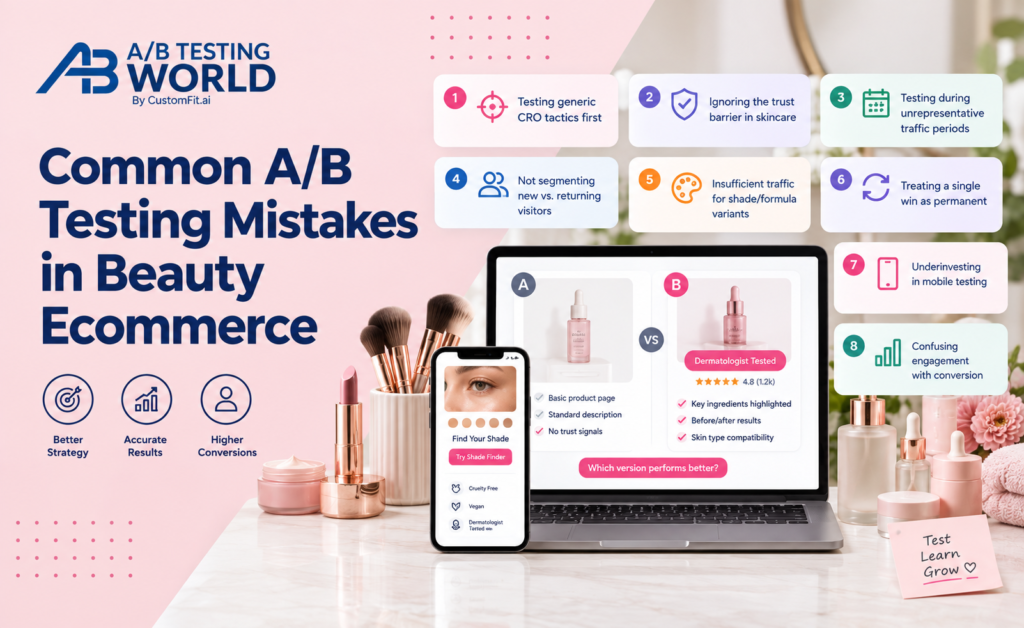
The most common skincare testing error is running the same playbook every ecommerce category runs first — CTA button color, headline wording, hero image swaps — while leaving shade-matching tools, ingredient transparency, and proof-of-efficacy imagery completely untested. These generic tests aren’t wrong, but they’re rarely where the biggest wins are hiding in beauty specifically. Prioritize the friction unique to your category before the friction common to every category.
Mistake 2: Ignoring the trust barrier unique to skincare
Skincare carries real, specific hesitation — ingredient sensitivity, allergic reaction risk, uncertainty about whether a formula actually suits a particular skin type. Cosmetics CRO mistakes often involve treating skincare like any other considered purchase, without specifically testing trust signals (certifications, dermatologist testing claims, specific guarantee language) that address this category’s distinct skepticism.
Mistake 3: Running tests during unrepresentative traffic periods
Testing during a major promotional period, an influencer collaboration launch, or right after a viral social moment can produce results that don’t hold up once traffic returns to normal. Beauty brand experimentation pitfalls frequently include drawing conclusions from a test window that happened to overlap with an unusual traffic spike or an atypical, highly primed audience.
Mistake 4: Not segmenting results by new vs. returning visitors
A test result that looks flat or negative in aggregate can be hiding a real, meaningful effect for one visitor segment and the opposite effect for another. This matters more in beauty than many categories, given how differently first-time and returning customers approach a purchase decision in a trust-sensitive category — always check segmented results before concluding a test had no effect.
Read Also: A/B Testing for Health & Wellness Brands on Shopify
Mistake 5: Testing shade or formula changes without enough traffic per variant
If your catalog spans many shades or formula variants, splitting already-limited traffic across too many simultaneous variations can leave every individual test underpowered. Avoid A/B testing mistakes beauty brands commonly make by consolidating test scope — fewer variants, more traffic per variant, clearer results — rather than testing every possible combination at once.
Mistake 6: Treating a single winning test as a permanent conclusion
Beauty trends, ingredient preferences, and even shade-matching technology expectations shift faster than in many other categories. A test that produced a clear winner a year ago may not hold up today — periodically re-testing previously “settled” decisions, particularly around messaging and proof formats, catches drift that a one-and-done testing mindset misses entirely.
Run These Tests on Your Own Store
Set up A/B tests without writing code. Install CustomFit.ai in 2 minutes and use every feature free for 14 days.
Mistake 7: Underinvesting in mobile-specific testing
Beauty shopping, especially discovery driven by social content, skews heavily mobile. A test that only accounts for desktop behavior, or that doesn’t separately verify how a shade-finder tool or quiz performs on mobile specifically, can miss significant friction that desktop testing alone wouldn’t reveal.
Mistake 8: Confusing engagement with conversion
A quiz, shade finder, or interactive tool can show strong completion rates and engagement metrics while still underperforming on the metric that actually matters — purchases. Track the full funnel from tool engagement through to actual conversion, not just whether shoppers interact with the feature itself.
How to avoid these mistakes going forward
1. Prioritize category-specific friction points before generic ecommerce tests. Shade matching, ingredient transparency, and proof-of-efficacy content should usually come before CTA copy and button color in your testing roadmap.
2. Always segment results by new versus returning visitors before drawing conclusions. An aggregate result can mask meaningfully different effects across these two groups, especially given how differently they approach trust in this category.
3. Avoid testing during unusually high-traffic promotional windows if you want results that generalize. Save major promotional periods for testing promotional-specific elements, and run your core page and tool tests during more typical traffic conditions.
4. Revisit previously “settled” tests periodically. What converted best a year ago in a fast-moving category like beauty may not still be optimal today — build re-testing into your ongoing roadmap rather than treating past winners as permanent.
The bottom line
Beauty ecommerce A/B testing mistakes are rarely about broken testing mechanics — they’re almost always about applying a generic testing approach to a category with distinct trust barriers, fast-moving trends, and heavily mobile, visually-driven shopping behavior. Avoiding these specific pitfalls matters more for getting reliable, actionable results than any improvement in testing tools or statistical rigor alone.
Stop Guessing. Start Testing.
Turn the ideas in this guide into real conversion gains. Test your store with CustomFit.ai, free for 14 days, cancel anytime.