A bundle can raise average order value and still leave you poorer if the discount is too deep, or if it simply relabels items people would have bought anyway. That is why bundle pricing strategy examples are more useful when you treat them as test variants, with revenue and margin both in the plan.
This post covers fixed bundles, mix and match bundle test designs, and tiered offers, plus what to measure in a bundle ab test. It is written for stores that already sell complementary items, including teams looking at product bundles shopify merchants can launch without a new product line.
customfit.ai has a broader guide to bundle pricing strategies that lift AOV. This article stays on the experiment: the variants, the metrics and a worked example where conversion, revenue and margin do not all move the same way.
Bundle Pricing Strategy Examples You Can Test
A product bundle pricing strategy examples list is not a merchandising catalog. Each type below is a variant you can run against “no bundle” or against another bundle rule.
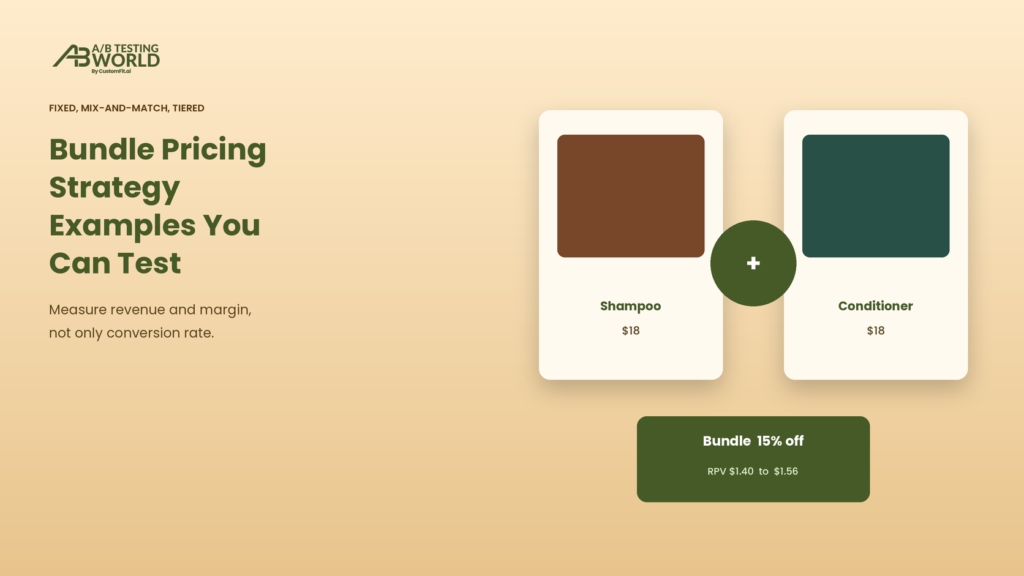
Fixed bundle. Two or more SKUs sold as one offer at a set price or a set percent off, such as a shampoo and conditioner pair, a sofa plus two cushions, or a starter kit. The test is usually “bundle on the product page versus the same items sold only as singles.”
Mix and match. The shopper picks a set number of items from a defined group, such as any three tees for a fixed price. This mix and match bundle test is harder to build and easier for the shopper to understand than a long list of pre-set pairs.
Tiered bundle. A spend or unit threshold, such as “buy two, get 15% off the third” or “add any three and save 20%.” The variant is the rule, not a single packaged SKU.
Buy-one-get-one or gift-with-purchase. These are bundles with a free or cheap add-on. They often move conversion more than they move margin, so the guardrail matters.
You can also change placement without changing the offer: a bundle block under the product description, a bundle as the default add-to-cart action, or a bundle offer in the cart. Placement and the price rule are two different tests. Do not change both at once if you want to know which one worked.
What to Measure in a Bundle A/B Test
Conversion rate alone is the wrong primary metric for most offer tests. A bundle can reduce order count and still raise revenue if the basket is larger, or raise orders and shrink margin if the discount is generous. Make revenue per visitor the primary metric, and make margin per visitor (or a close proxy) a pre-registered guardrail. See how to choose the right metrics for A/B testing.
Also log:
- Attach rate: the share of orders that include the bundle or the complementary SKU.
- Average order value, as a supporting number, not as the decision metric (it ignores people who did not buy).
- Discount rate, so you can see how much of the lift you paid for.
- Return rate, if the bundle could increase exchanges.
If you cannot get margin into the dashboard, at least compute it in the write-up from discount and cost. Shipping a bundle that wins on revenue and loses on margin is a merchandising decision, not a stats decision, and it should be made on purpose.
A Worked Ecommerce Example
A body-care store tested a fixed bundle on the shampoo product page: shampoo plus conditioner at 15% off the combined single price, versus no bundle. The test ran 14 days, 50/50, on 20,000 visitors per group.
Control had 800 orders and $28,000 in revenue. Revenue per visitor was $1.40, conversion rate was 4.00%, and average order value was $35.00. At a 52% gross margin, margin per visitor was $0.728.
The bundle variant had 760 orders and $31,200 in revenue. Revenue per visitor was $1.56, a 11.4% lift. Conversion rate fell to 3.80%. Average order value rose to $41.05. Because of the 15% bundle discount, gross margin on those orders fell to 47%, and margin per visitor was $0.733.
Revenue per visitor rose. Margin per visitor was essentially flat. Conversion rate fell, and would have looked like a loss if it had been the primary metric. The honest decision, under a rule of “ship if revenue per visitor rises and margin per visitor is not clearly down,” is to ship the bundle and then test a shallower discount, or a mix-and-match rule, if you want more margin later.
Those revenue figures are a planning-size example, not a promise that your 15% pair will move the same way. Size the test with the A/B test sample size formula, and expect a revenue metric to need a larger sample than a conversion-rate test of the same relative lift.
Design Notes That Change the Result
A bundle ab test is easy to bias. If the variant also gets a new badge, a new photo and a new offer, you will not know what to keep. Change the offer or the placement, not the whole product page.
Watch cannibalization. If people who would have bought both singles now buy the bundle at 15% off, revenue can still rise while profit does not. That is why margin per visitor belongs in the report.
Watch inventory. A mix and match bundle test that includes a slow-moving color can look good in week one and stall when that color sells out. Exclude out-of-stock SKUs from the offer, or the split will drift.
On product bundles shopify stores often launch from an app, confirm that assignment is stable and that the bundle SKU does not break inventory or discount stacking. A messy implementation is a sample-ratio or tracking problem, not a pricing insight. If the split looks uneven, stop and use sample ratio mismatch checks before you read the lift.
Read more: Free Shipping Threshold Testing: Find the Number That Pays
Test the Bundle on Your Store
Run the offer as an experiment, with revenue per visitor as the primary metric and margin as a guardrail. Try CustomFit.ai free for 14 days.
A good next test, after a fixed bundle ships, is usually a pricing rule, not a new creative: 10% off versus 15% off, or a tiered “buy two, save more” rule versus the fixed pair. Keep the placement constant so you can read the price.
The same pattern holds across categories, even if the items change. A jewelry store might pair a chain and a pendant, or test a “complete the set” offer against singles, as in our A/B test ideas for jewelry brands. A pet store might bundle food with a supplement. A furniture store might pair a sofa with cushions, where the margin risk is larger and the delivery story has to sit in the offer, not only the price.
In every case the questions are the same. Does the shopper see the bundle without hunting? Is the discount shallow enough that margin per visitor does not fall? Are the items actually complementary, or did you package two slow movers and hope? A test will not fix a weak pair, but it will stop you from rolling a weak pair to 100% of traffic.
If the first test is inconclusive, do not immediately deepen the discount. First check that people saw the offer (a click or scroll on the bundle block) and that the split was clean. A larger discount is a new test, and it should have its own margin guardrail.
A bundle is also the wrong lever when the catalog does not have natural pairs, when the discount would have to be so deep that margin per visitor cannot hold, or when fulfillment cannot ship the items together. In those cases, test a cross-sell or a threshold offer instead, and keep the singles intact. The point of a bundle ab test is to learn whether a packaged price is worth the complexity, not to force a packaged price onto a catalog that does not support it.
Write the offer in one sentence in the hypothesis, including the discount and the items. If you cannot say it clearly, the shopper probably cannot either, and the test will spend its traffic on confusion rather than on a price rule.
Kohavi, Tang and Xu, in Trustworthy Online Controlled Experiments, treat revenue and a business constraint as the pair that should drive the decision. A bundle is a clean case of that advice: the lift is not finished until margin has been checked.
Test the Bundle on Your Store
Launch a fixed, mix-and-match or tiered offer as a real experiment. Try CustomFit.ai free for 14 days, no credit card required.
Summary
Use bundle pricing strategy examples as test variants, not as slogans. A product bundle pricing strategy examples set that is worth running usually includes a fixed pair, a mix and match bundle test, and a tiered rule, each compared with a clear primary metric. In a bundle ab test, make revenue per visitor the decision metric and keep margin per visitor as a guardrail, because conversion rate can fall while revenue rises. In the worked example, a 15% shampoo-and-conditioner pair lifted revenue per visitor from $1.40 to $1.56 and left margin roughly flat. Product bundles shopify teams launch from an app still need a stable split and a clean inventory rule before anyone should trust the lift.
FAQs
What are useful bundle pricing strategy examples to test first?
Start with a fixed pair of items people already buy together, on a high-traffic product page, versus no bundle. It is easier to build and easier to explain than a mix-and-match engine, and it still tests the core idea: a packaged price against singles.
How do product bundle pricing strategy examples differ from a merchandising idea?
A merchandising idea can ship to everyone on Monday. A test has a control, a planned sample, a primary metric and a guardrail. The same bundle can be either, but only the test tells you whether the offer earned its discount.
What should a bundle A/B test use as the primary metric?
Use revenue per visitor, not conversion rate, when the offer changes basket size or discounting. Register margin per visitor, or a close proxy, as a guardrail so a cheaper mix of orders cannot hide behind a revenue win.
What is a mix and match bundle test?
It is a test of a rule such as “any three tees for a fixed price,” rather than a pre-packed pair of SKUs. The variant is the rule and the picker UI. Keep the rest of the product page constant, and watch inventory on the included items.
Can I test product bundles on Shopify without a custom app build?
Many stores can, with a theme block or a bundle app. The harder part is assignment and tracking: the bundle SKU must not break inventory, discounts or the split. If visitor counts drift, fix the implementation before you read revenue.
Why might conversion fall if the bundle is working?
A higher price or a more prominent pair can reduce smaller orders while raising revenue per visitor. That is a reason to use revenue as the primary metric, not a reason to ignore a sharp drop in conversion if margin also falls.