Email is still one of the few places a store can test a message without touching the live theme. That is why a focused set of email AB testing ideas belongs in the same backlog as your on-site experiments. The catch is that an open or a click is not revenue, and a list that looks large can still be too small for a purchase test.
This post gives you 40 tests across subject lines, preheaders, offers, send time and flows, plus the sample-size rules that make email ab testing statistical significance a real number instead of a hunch. It also covers how to read ab testing email campaigns against on-site revenue, not only against the email tool’s dashboard.
These are email ab testing best practices for teams that already send campaigns and flows, not a beginner tutorial on setting up an ESP. If you send fewer than one campaign a week, start with a cart or welcome flow test, because those emails already have a built-in audience and a closer tie to orders than a one-off newsletter.
Email AB Testing Ideas: 40 Tests
Each line is a prompt. Write a hypothesis and one primary metric before you send. For subject line ab testing, that metric is usually unique opens or, better, unique clicks. For offers and flows, move the primary metric as close to revenue as your list can support.
Subject lines (ideas 1 to 8)
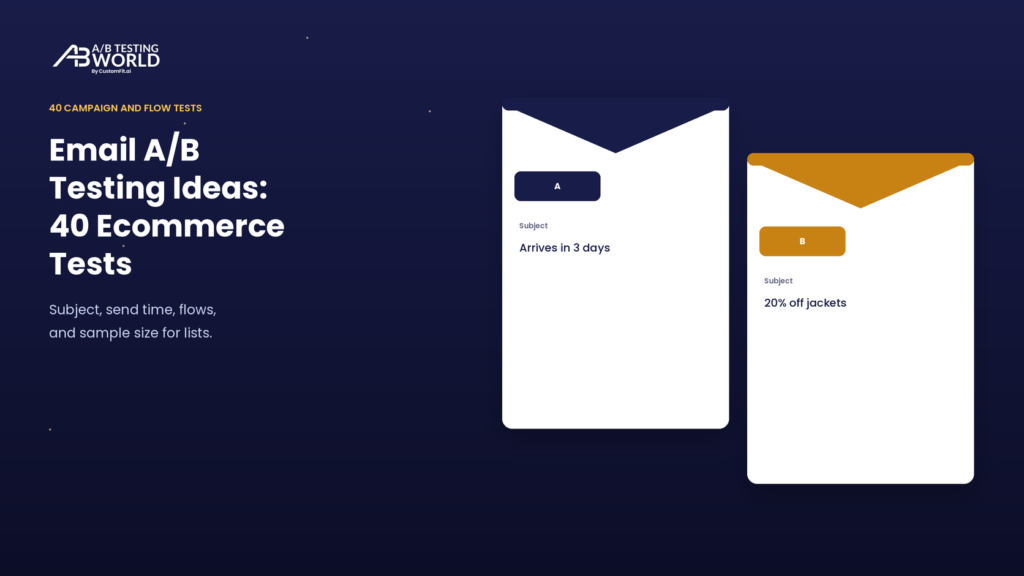
- 1. A benefit in the subject (“arrives in three days”) versus a product name only.
- 2. A specific offer (“20% off jackets”) versus a vague “sale starts now.”
- 3. The product name first versus the offer first.
- 4. A question versus a statement, on the same offer.
- 5. A short subject (under 40 characters) versus a longer descriptive one.
- 6. Personalization with first name versus no name, on a list that has clean names.
- 7. An emoji at the start versus the same line with no emoji.
- 8. A restock or back-in-stock subject versus a generic “just dropped” line.
Preheaders (ideas 9 to 13)
- 1. A preheader that completes the subject versus one that repeats it.
- 2. A preheader that states the expiry of the offer versus one that states a product detail.
- 3. A preheader with a second offer (free shipping) versus no second offer.
- 4. A blank or nearly blank preheader versus a written one, only if your ESP allows it.
- 5. A preheader that names the category (“for running”) versus one that names the discount.
Offer and content (ideas 14 to 21)
- 1. A single hero offer versus a grid of four products.
- 2. A code the reader must type versus an automatic discount link.
- 3. A percentage off versus a dollar amount off, at the same discount value.
- 4. A free-shipping offer versus a percentage off, on the same audience.
- 5. One CTA button versus two (shop the sale and shop bestsellers).
- 6. A UGC or review block in the email versus a studio product shot only.
- 7. A long story plus one product versus a short line plus the same product.
- 8. A deadline in the body versus no deadline, only when the end date is real.
Send time (ideas 22 to 26)
- 1. Morning (8 to 10 local) versus evening (18 to 20 local) on a weekday.
- 2. Tuesday versus Thursday, at the same clock time.
- 3. Weekend morning versus weekday morning, on a non-operational send.
- 4. Send immediately when a campaign is ready versus a 24-hour delay to hit a chosen slot.
- 5. A follow-up send to non-openers, 24 hours later, versus no follow-up.
Flows and lifecycle (ideas 27 to 36)
- 1. Welcome flow: a discount in email one versus education in email one and a discount in email two.
- 2. Welcome flow length: two emails versus four, over the same week.
- 3. Abandoned cart: first reminder at one hour versus at four hours.
- 4. Abandoned cart: a 10% code in the first reminder versus no code until the second.
- 5. Abandoned checkout: a payment-reassurance email versus a product-only reminder.
- 6. Browse abandonment: one product versus three from the same category.
- 7. Post-purchase: a review request at delivery versus three days later.
- 8. Post-purchase: a cross-sell on day three versus a refill or reorder reminder on day 14.
- 9. Winback: a 15% offer versus a “new in” merchandising email with no discount.
- 10. Replenishment: a reminder timed to the average reorder cycle versus a fixed 30-day send.
Design and technical (ideas 37 to 40)
- 1. A dark-background template versus a light one, on the same content.
- 2. A single large CTA versus a smaller text link under the same image.
- 3. Plain-text (or mostly text) versus a designed HTML version, on a transactional or service send.
- 4. AMP or interactive blocks versus a standard static email, only if your audience actually supports them.
Those 40 email ab testing ideas are enough for a year of campaigns and flow work. Do not test two subject changes and a new offer in the same send unless you have a multivariate design and the list size to match.
Read more: A/B Test Hypothesis Template: Write One You Can Test
Test the Offer, Then Test the Email
Run the on-site experiment that your campaign is trying to support, with a clear primary metric and a stable split. Try CustomFit.ai free for 14 days.
Email A/B Testing Statistical Significance and List Size
Email tools often call a subject line a “winner” after a few hours. That is usually a peek at opens, not a finished test. If you care about email ab testing statistical significance, set the sample and the runtime in advance, the same way you would on a product page.
A worked example, using a two-proportion test at 80% power and a 5% two-sided level:
- Unique open rate of 20%, looking for a 10% relative lift (to 22%): about 6,500 recipients per variant.
- Unique click rate of 2.5%, looking for a 15% relative lift (to 2.88%): about 29,000 per variant.
- Purchase rate from the email of 0.40%, looking for a 20% relative lift (to 0.48%): about 107,000 per variant.
Most lists can support a subject-line test on opens. Many cannot support a purchase-rate test on a single campaign. In that case, either combine similar campaigns, run the offer test on-site, or accept that clicks are a proxy and say so in the write-up. Our A/B test sample size formula is the same math, with email recipients in place of sessions.
Do not stop a 48-hour send at hour four because opens look decisive. Late openers and other time zones still have to arrive, and a newsletter that is opened on the commute home should still count toward the planned sample. The same early-stopping problem is described for on-site tests in the peeking problem in A/B testing.
How to Tie Email Tests to On-Site Revenue
Ab testing email campaigns only earns its keep if someone can see what the send did to the store. Tag every variant with a distinct UTM (or a comparable ESP parameter), then read revenue, orders and conversion from that campaign in your analytics, not only in the email tool.
A useful habit is to report three numbers together: unique clicks, purchases attributed to the send, and revenue per recipient (total attributed revenue divided by the number of people in that variant). Revenue per recipient is often a better primary metric than click rate when the offer changes the mix of products people buy.
If the email promotes a landing page, test the landing page as its own experiment when you can. A winning subject that sends people to a weak page will still look poor on revenue. For the on-site metric choice, see how to choose the right metrics for A/B testing.
When a flow email and an on-site change overlap (for example a cart reminder and a new cart upsell), do not give both tests credit for the same orders. Pick one primary owner for that period, or hold the second change until the first test ends.
Three mistakes show up often enough to name. The first is testing a subject line on 10% of a 4,000-person list and calling a 3-point open-rate gap a winner. That sample is far below the 6,500-per-variant figure above. The second is changing the subject, the hero and the offer in one send, then not knowing what to keep. The third is treating a flow as if it were one email: if you change email one of a four-part welcome series, keep the rest constant and measure the series, not only the first open.
If the list is seasonal, check that both variants ran across the same days of the week. A Tuesday-only test of a “weekend plans” subject is a design error, not a stats error.
customfit.ai’s broader funnel-stage testing ideas include email as part of the path to purchase. This article stays on the tests you run inside the campaign and the flow.
Run the On-Site Test Your Email Supports
Launch the experiment on your store and read it against revenue, not only against opens. Try CustomFit.ai free for 14 days, no credit card required.
Summary
A practical set of email ab testing ideas covers subject lines, preheaders, offers, send time, flows and design, and then stops to ask whether the list is large enough. For subject line ab testing, a 10% relative lift in a 20% open rate needs about 6,500 recipients per variant at 80% power. Purchase-rate tests need much more, often more than 100,000 per variant. Treat email ab testing statistical significance as a planned sample, not a mid-send badge, and read ab testing email campaigns against revenue per recipient, not only against opens. That is the core of email ab testing best practices that a store can defend.
FAQs
What are the best email A/B testing ideas to start with?
Start with a subject line or a cart-flow change, because those tests have clear metrics and happen often. Save AMP blocks and full template redesigns until you have a habit of finishing simpler tests and writing down the result.
What are email A/B testing best practices for ecommerce?
Plan the sample and the primary metric before you send, test one main change at a time, wait for the planned window, and report revenue per recipient alongside opens and clicks. Do not call a campaign a winner on a four-hour open-rate peek.
How much list size do I need for email A/B testing statistical significance?
For a 20% open rate and a 10% relative lift, plan about 6,500 recipients per variant at 80% power and a 5% two-sided test. Click and purchase tests need more, often tens or hundreds of thousands, depending on the baseline.
Is subject line A/B testing enough to judge a campaign?
No. A subject line can win on opens and still lose on clicks or revenue if the body or the offer is weak. Use opens as the primary metric only when the test is actually about the subject, and still report downstream numbers.
How should I judge A/B testing email campaigns against the store?
Give each variant a distinct UTM, then read purchases and revenue in analytics. Revenue per recipient is a useful primary metric for offer tests, because it captures both the conversion rate and the mix of items people buy.
Can I test a flow and a campaign at the same time?
Yes, if they do not fight over the same people in the same hour. If a campaign and an abandoned-cart reminder overlap, hold one back or accept that you may not be able to separate the two effects.