Starting an A/B testing program without a clear list of what to actually test is one of the most common places brands stall out. These ten A/B test ideas beauty brands can run are specific enough to implement directly, and ordered roughly by how much impact they tend to have for a typical skincare or cosmetics store.
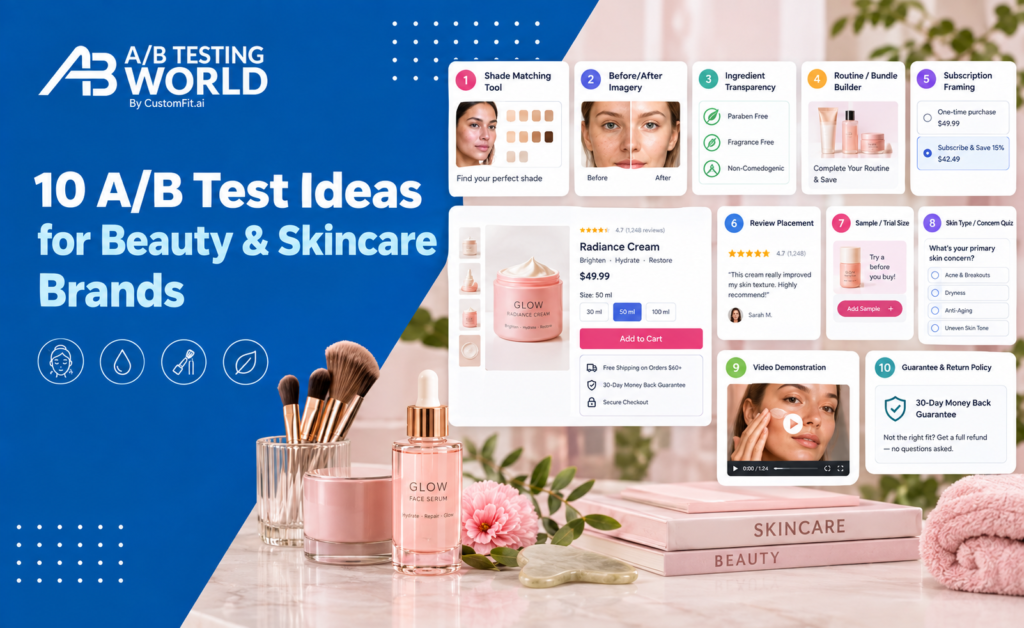
1. Shade-matching tool vs. standard dropdown selector
For makeup and complexion products, shade selection is frequently the single biggest point of hesitation. Test a visual or AI-based shade finder against a plain dropdown — this is consistently one of the highest-impact skincare A/B testing examples available for color-cosmetics brands specifically.
2. Before/after imagery vs. aspirational lifestyle photography
Test genuine before/after results (photos or video) against purely aspirational brand imagery. Skincare shoppers are frequently looking for proof of efficacy, and real results tend to outperform polished lifestyle photography that doesn’t actually demonstrate the product working.
3. Ingredient transparency callouts vs. standard ingredient list
Test a prominent “what’s not in it” or key active ingredient callout (fragrance-free, non-comedogenic, specific active percentage) against a standard ingredient list buried lower on the page. This is a cheap, fast test with reliably strong signal in beauty specifically.
4. Routine or bundle builder vs. individual product listings
Test a “build your routine” bundle tool against selling cleanser, serum, and moisturizer as entirely separate listings. Beauty purchases are naturally routine-based, and this is one of the more reliable beauty brand experiment ideas for lifting average order value.
5. Subscription framing: percentage discount vs. dollar amount
Test how your subscribe-and-save offer is framed — “save 15%” versus “save $8” — on the same product page. The better-performing framing isn’t consistent across every brand or price point, which is exactly why it’s worth testing directly rather than guessing.
Read Also: A/B Testing for Beauty Brands on Shopify: What to Test First
6. Review placement: immediately under add-to-cart vs. lower on the page
Experiment with moving the star rating and review summary above the add-to-cart. In trust-sensitive areas such as beauty, it may be more important where reviews are placed than the product status.
7. Sample or trial size as a cart add-on vs. full-size only
You should test whether it’s better to offer samples as a cart add-on or only allow complete purchases. This is one of the best experiments for cosmetic conversion aimed at first-time customers, who don’t trust a new product.
8. Skin type or concern quiz vs. standard category browsing
When a brand has different products for different skin types or issues, you should test a few weeks of guided quiz on skin issues against a standard product category browsing.
9. Video demonstration vs. static product photography
Test adding application or texture demonstration video to top product pages against photo-only galleries. This matters more in beauty than in many categories, since texture and application method are hard to convey through still images alone.
10. Guarantee and return policy prominence near the CTA
Test a specific, visible guarantee (“30-day money-back guarantee if it’s not right for your skin”) placed near the add-to-cart button against a generic return policy link in the footer. This is one of the simplest beauty product page tests to implement and consistently reduces first-purchase hesitation for new-to-brand shoppers.
How to prioritize these ten tests
Given limited testing bandwidth, a reasonable order for most beauty and skincare brands:
- Shade-matching or skin-type tools (usually the highest-friction point)
- Before/after or proof-based imagery
- Ingredient transparency callouts
- Guarantee placement near the CTA
- Review placement
- Routine/bundle builder
- Sample size add-ons
- Subscription framing
- Video demonstration
- Quiz-based category filtering
This sequencing prioritizes resolving core product-match uncertainty first, then moves toward tests focused on trust and order value once the base conversion barrier is addressed.
Common mistakes when running these tests
The most common mistake is starting with the easiest tests to implement (subscription framing, review placement) rather than the ones most likely to have real impact (shade-matching, proof-based imagery) — ease of setup and actual impact aren’t the same thing, and a well-prioritized roadmap should weight impact more heavily. The second is running several of these tests simultaneously on the same page, which makes it difficult to attribute any resulting lift to a specific change.
The bottom line
These ten A/B test ideas beauty brands can draw from cover the highest-impact, most category-specific friction points in skincare and cosmetics ecommerce — shade matching, proof of efficacy, ingredient transparency, and trust signals, in roughly that order of importance. Running them in a deliberate sequence, rather than all at once or in order of ease, will get you to meaningful conversion gains faster than a generic, category-agnostic testing checklist.